Preparing for WHO-GMP certification is not about collecting more files before an inspection. It is about proving that your pharmaceutical quality system works consistently in practice.
WHO defines GMP as the quality-assurance system that ensures medicinal products are consistently produced and controlled to appropriate quality standards. India’s revised Schedule M similarly requires pharmaceutical manufacturers to maintain documented systems and procedures for inspection. World Health Organization
What Is GMP Certification—and Who Gives It in India?
If you are researching what is GMP certification, one distinction matters immediately: WHO publishes GMP guidance, but it does not routinely inspect every Indian pharmaceutical factory.
In India, manufacturing sites are inspected through the applicable central and state regulatory process. CDSCO also publishes lists of WHO-GMP certified manufacturing units for Certificates of Pharmaceutical Products (CoPPs), including a list current to 31 December 2025 that was released in June 2026. CDSCO
So, when someone asks who gives GMP certification in India, the answer depends on the regulatory purpose. A commercial certificate from a private certification body should not automatically be treated as equivalent to regulatory WHO-GMP status.
What Auditors Actually Check
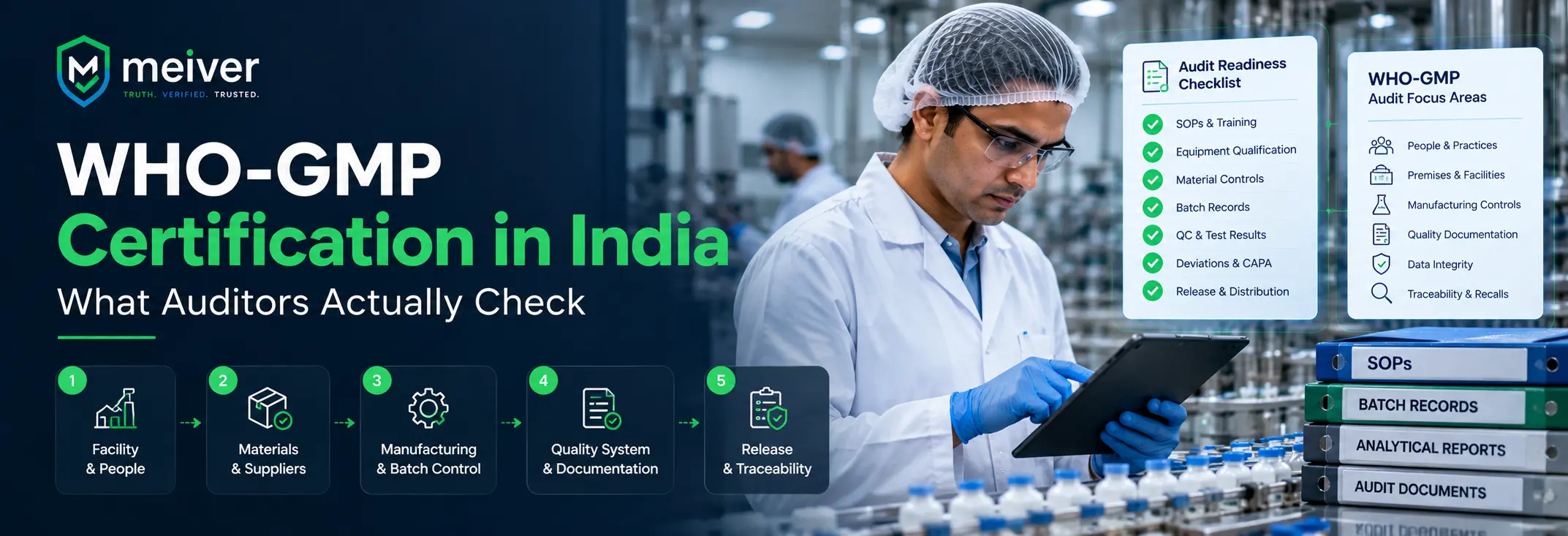
Auditors look beyond SOPs. They follow the evidence trail across facilities, people, materials, manufacturing, testing and release.
WHO GMP guidance expects production and testing processes to be defined, validated, reviewed and documented, with suitable personnel, premises and materials. World Health Organization
Evidence may include:
Training and hygiene records
Equipment qualification, calibration and maintenance
Approved suppliers and material specifications
Executed batch and packaging records
In-process controls and QC test results
Deviations, investigations, CAPA and change control
Batch-release, complaint and recall records
The practical question is not only “Do you have an SOP?” It is “Can your records prove that it was followed for this batch?”
Five Audit Areas to Prepare For
Stage | What auditors examine | Evidence manufacturers should have ready |
01. Facility & People | Premises, hygiene, roles, training | Cleaning, training, maintenance records |
02. Materials | Supplier approval, receipt and material controls | Specifications, supplier evidence, test records |
03. Manufacturing | Process execution and batch control | Batch records, SOPs, IPC results, deviations |
04. Quality System | QC, validation, CAPA, change control | CoAs, QC records, validation/CAPA evidence |
05. Release & Traceability | Batch disposition, complaints and recalls | Release approval, distribution and recall records |
Audit depth is not identical for every facility; it varies with the product, dosage form, site, risk and regulatory purpose.
How to Get GMP Certification in India
For manufacturers asking how to get GMP certification in India, preparation usually begins by identifying the applicable licence, product category and GMP certification requirements.
The manufacturer then conducts a gap assessment, improves required systems, trains personnel, generates compliant records and prepares for inspection by the competent authority.
Revised Schedule M specifically requires appropriate methodologies, systems and procedures to be documented and maintained for inspection and reference. CDSCO
There is no universal shortcut to GMP certification India readiness.
How to Check GMP Certification in India
Knowing how to check GMP certification in India is equally important when qualifying a contract manufacturer or supplier.
Do not rely only on a certificate image. Verify the:
Manufacturing-site name and address
Certificate scope
Issuing authority
Validity period
Products or dosage forms covered
For WHO GMP certification India and CoPP-related status, review current CDSCO information and confirm with the relevant authority when required. CDSCO
Where Meiver Fits
GMP defines how pharmaceutical manufacturing and quality systems should operate. Meiver does not issue certification and should not be positioned as a replacement for a validated pharmaceutical QMS, MES or eBMR system.
Its relevance is the evidence layer: Meiver can connect batch information, production stages, supporting documents, CoAs, approvals and recall information for traceability and retrieval. Its documented platform links supporting documents directly to batches and maintains historical batch records. MeiverFeatureReference
That becomes valuable when an auditor, buyer or quality team needs to reconstruct what happened to a specific batch rather than search through disconnected files.
Conclusion
WHO-GMP audits are evidence checks, not document-counting exercises. Strong readiness means being able to reconstruct what happened to an actual batch—from materials received and processes followed to testing, release and recall readiness.
For pharmaceutical manufacturers, that traceable evidence is increasingly important not only during audits, but also when building confidence with export buyers, partners and quality-conscious customers.
FAQs
1. Is WHO-GMP certification for food manufacturers?
Generally, no. Indian food manufacturers and many food-regulated nutraceuticals operate under FSSAI requirements rather than pharmaceutical WHO-GMP.
2. Is WHO-GMP mandatory for every Indian pharmaceutical manufacturer?
Applicable GMP obligations arise from India’s drug regulatory framework. Specific WHO-GMP or CoPP requirements depend on the product, licence and intended market.
3. How long does GMP certification take?
There is no universal timeline. It depends on facility readiness, identified gaps, documentation, validation requirements and the regulatory inspection process.
4. What is a common GMP audit weakness?
A common weakness is the gap between written procedures and records proving consistent execution. Having an SOP is not enough if the corresponding batch, QC, training or investigation evidence is incomplete.