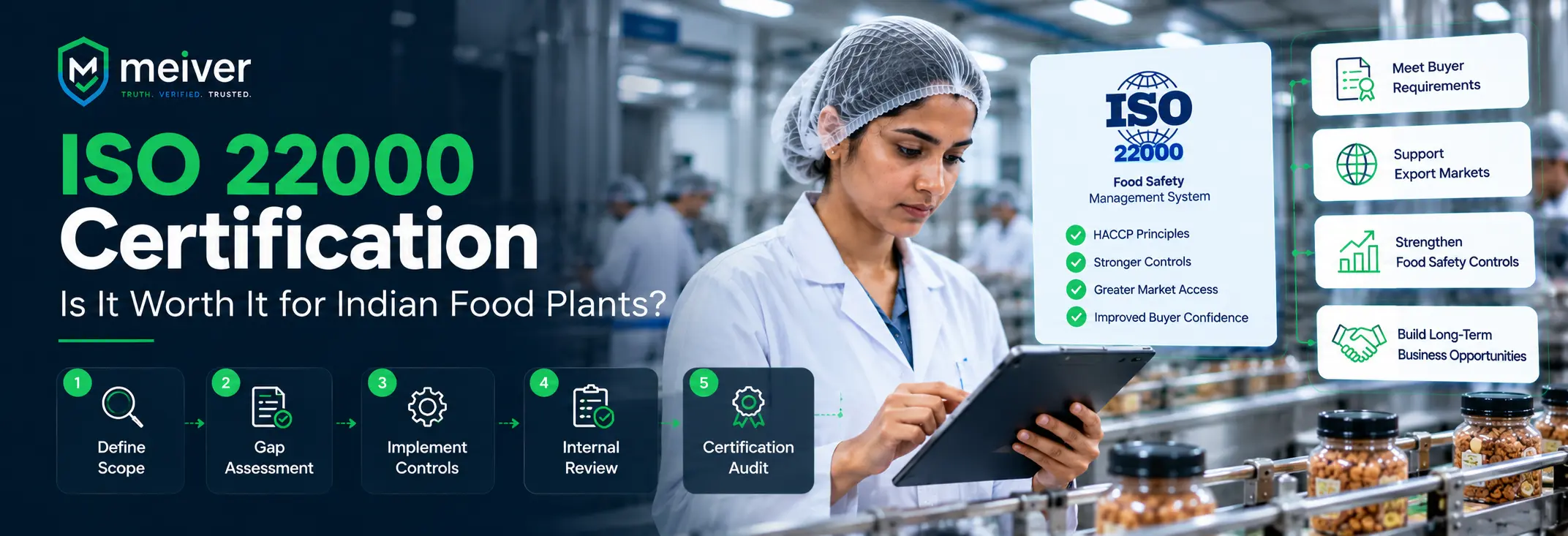
For an Indian food plant, ISO 22000 certification is not automatically a “must-have.” The better question is whether it solves a real business need: winning customers, entering markets or strengthening food-safety controls.
FSSAI already requires licensed food businesses to maintain a documented Food Safety Management System (FSMS) and comply with applicable Schedule 4 hygiene requirements. ISO 22000 adds an internationally recognised management-system framework, but certification itself is voluntary. FSSAI
What Is ISO 22000 Certification?
The ISO 22000 certification meaning is simple: an independent certification body audits whether your food-safety management system meets ISO 22000 requirements. The standard brings together HACCP principles, prerequisite programmes, communication and management-system controls.
ISO itself does not certify companies, and organisations may use the standard without certification. Its value usually comes from confidence, operational discipline and market access. ISO
ISO 22000 vs FSSC 22000
ISO 22000 and FSSC 22000 are not interchangeable.
FSSC 22000 is a separate certification scheme built on ISO 22000, applicable prerequisite-programme standards and FSSC-specific additional requirements.
FSSC 22000 Version 7, released in May 2026, incorporates the ISO 22002-x:2025 PRP series and GFSI-linked updates. For food manufacturers, the new framework uses the common ISO 22002-100:2025 requirements together with the applicable sector-specific PRP standard. FSSC
If a buyer specifically requires a GFSI-recognised scheme, ISO 22000 alone may therefore not satisfy that commercial requirement.
When Is ISO 22000 Certification Worth It?
ISO 22000 certification India makes the most sense when it supports a clear objective:
Meeting a buyer or tender requirement
Supporting export or modern-trade discussions
Formalising controls as the plant scales
Improving consistency in records and corrective actions
It may be less urgent when no customer requires it and the plant already operates a strong, compliant FSMS.
The certificate should solve an operational or commercial problem—not simply become another logo on the company website.
What Determines ISO 22000 Certification Cost in India?
There is no official fixed ISO 22000 certification cost.
The ISO 22000 certification cost in India varies with plant complexity, certification scope, employees, shifts, food-chain category, number of sites, audit duration, travel, surveillance and follow-up.
Separate certification fees from implementation costs. A mature plant may need less preparation than one rebuilding PRPs, HACCP and documentation.
How to Get ISO 22000 Certification
ISO 22000 Certification Process — Infographic Table
Step | What Happens | Practical Output |
1. Define scope | Identify sites, products, processes and goals | Clear FSMS boundary |
2. Gap assessment | Compare the current system with ISO 22000 | Action plan |
3. Implement controls | Strengthen PRPs, HACCP, procedures and training | Audit-ready system |
4. Internal review | Complete internal audit, management review and corrections | Major gaps closed |
5. Certification audit | Accredited body audits the system | Certification if requirements are met |
For ISO 22000 certification in Chennai or ISO 22000 certification in Bangalore, choose based on accreditation, valid scope and food-sector competence—not proximity or price. NABCB maintains current accreditation records for Food Safety Management System certification bodies in India. NABCB
Also remember: a consultant helps prepare your system; a certification body independently audits it.
Where Does Meiver Fit?
Meiver does not issue ISO 22000 certification, and using Meiver does not make a plant ISO 22000 compliant.
Its role is operational. Meiver can connect batches with supporting documents, approvals and historical records; its production stages can record who performed an activity, when and where; and its CoA functionality can associate structured testing information and original lab documents with the relevant batch. MeiverFeatureReference MeiverFeatureReference MeiverFeatureReference
That makes evidence easier to retrieve during reviews, investigations and audits.
Suggested internal links: Batch & Stages Management → CoA → Traceability → Recall Management.
Conclusion
ISO 22000 is worth considering when it solves a real commercial or food-safety-management need.
Start with the buyer requirement, export goal, operational gap or growth objective. Then decide whether ISO 22000, FSSC 22000 or a strong FSSAI-compliant FSMS without voluntary certification is the right next step.
That is more useful than pursuing certification simply because competitors display the badge.
FAQs
1. Is ISO 22000 mandatory in India?
No. FSSAI requires a documented FSMS and applicable Schedule 4 compliance, but ISO 22000 certification is not universally mandatory for Indian food plants. FSSAI
2. How much does ISO 22000 certification cost?
There is no standard national fee. Request quotations for your actual scope and separate certification charges from consultancy and implementation costs.
3. How long does ISO 22000 certification take?
It depends on readiness. Significant PRP, HACCP, training or documentation gaps can extend the preparation period.
4. Should I choose ISO 22000 or FSSC 22000?
Start with customer requirements. If a buyer requires a specific GFSI-recognised scheme, verify that requirement before choosing ISO 22000 alone. FSSC 22000 Version 7 is the current scheme version.