A packaging redesign is expensive. Discovering that your team misunderstood a notification after printing thousands of pouches is worse.
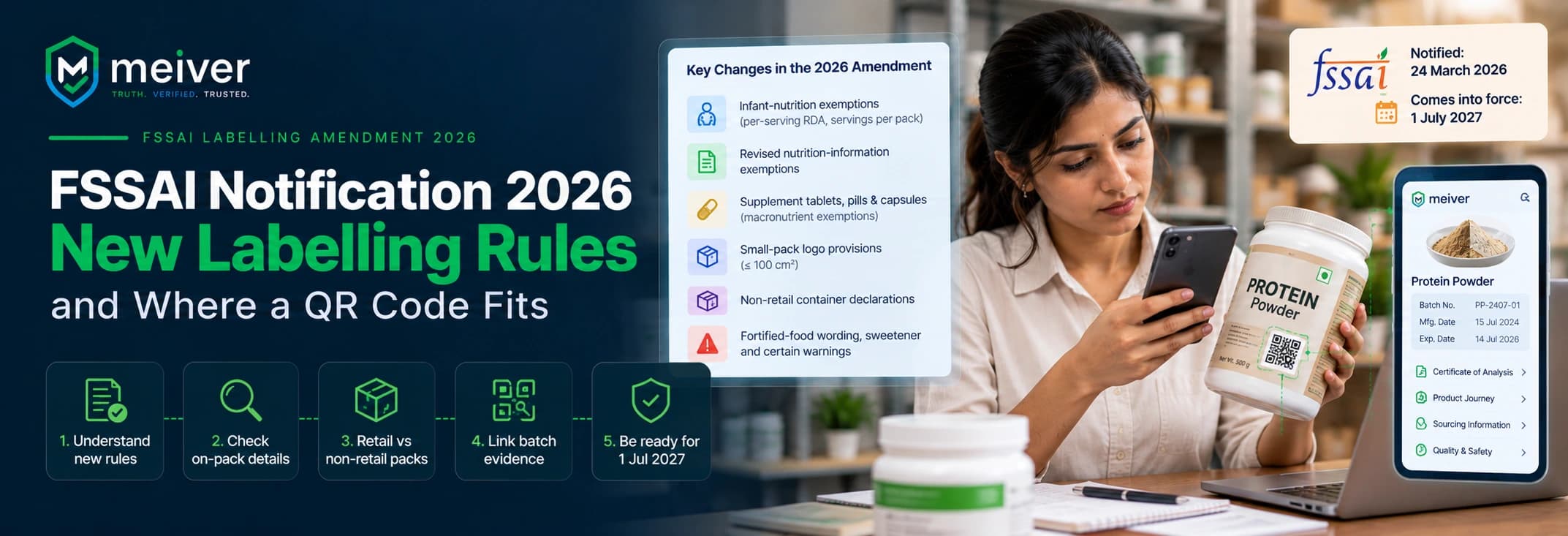
The FSSAI notification 2026 discussed here is the Food Safety and Standards (Labelling and Display) First Amendment Regulations, 2026, dated 24 March 2026. Its stated commencement date is 1 July 2027. Notification and implementation are different milestones. fssai.gov.in
For Indian food brands and manufacturers, the practical questions are: what affects your products, what belongs on the package, and where can digital information help?
1. What are the FSSAI labelling changes?
The amendment updates the FSSAI labelling and display regulations, covering several categories:
Infant-nutrition exemptions for per-serving RDA percentages and servings per pack.
Revised nutrition-information exemptions for minimally processed and single-ingredient foods.
Macronutrient exemptions for specified supplement tablets, pills and capsules with insignificant energy contribution.
Logo provisions for packs measuring no more than 100 cm², with information on multi-unit packages.
Non-retail declarations, fortified-food wording, and certain sweetener and warning statements. fssai.gov.in
Start with product classification. A protein powder, snack pouch and nutraceutical capsule should not receive an identical artwork review.
2. Separate retail packs from non-retail containers
A consumer-facing snack packet differs from a bulk container supplied to another food business.
Under amended Regulation 10, non-retail containers generally carry food identity, FSSAI logo/licence number, batch identification, manufacturer/packer details, and dates/storage instructions where required for safety or integrity. Imported packages also require country-of-origin information.
Ingredients, veg/non-veg declarations and net quantity can appear in accompanying documents under the specified conditions. For transportation units unsuitable for labelling, appropriate alternatives—including electronic exchange between businesses—are permitted, provided information remains traceable to the food. fssai.gov.in
Treat these as specific non-retail provisions, rather than permission to remove declarations from retail packaging.
3. Can a QR code replace mandatory label information?
No general replacement permission is established by this amendment.
FSSAI’s 12 October 2023 accessibility advisory encourages QR codes containing comprehensive product information to help visually impaired individuals. It explicitly says QR codes do not replace mandatory physical-label information. Neither document establishes a universal QR mandate. fssai.gov.in
Your approach to FSSAI labelling should therefore be: retain required on-pack declarations and add useful digital detail.
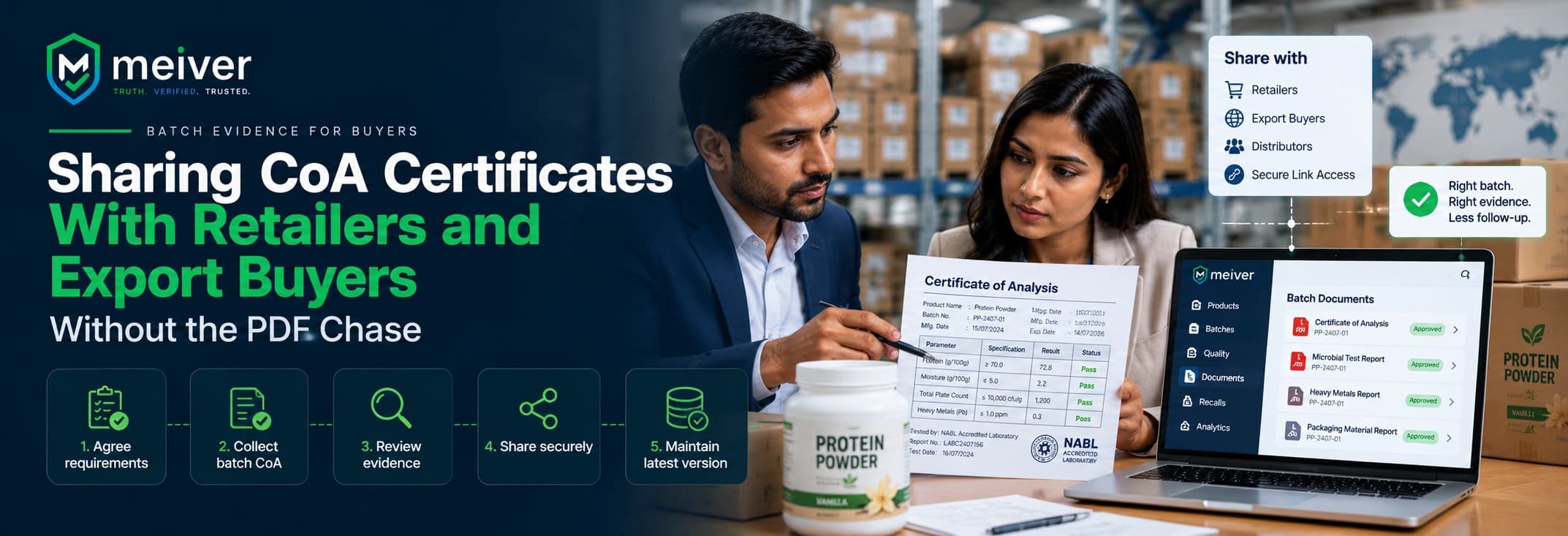
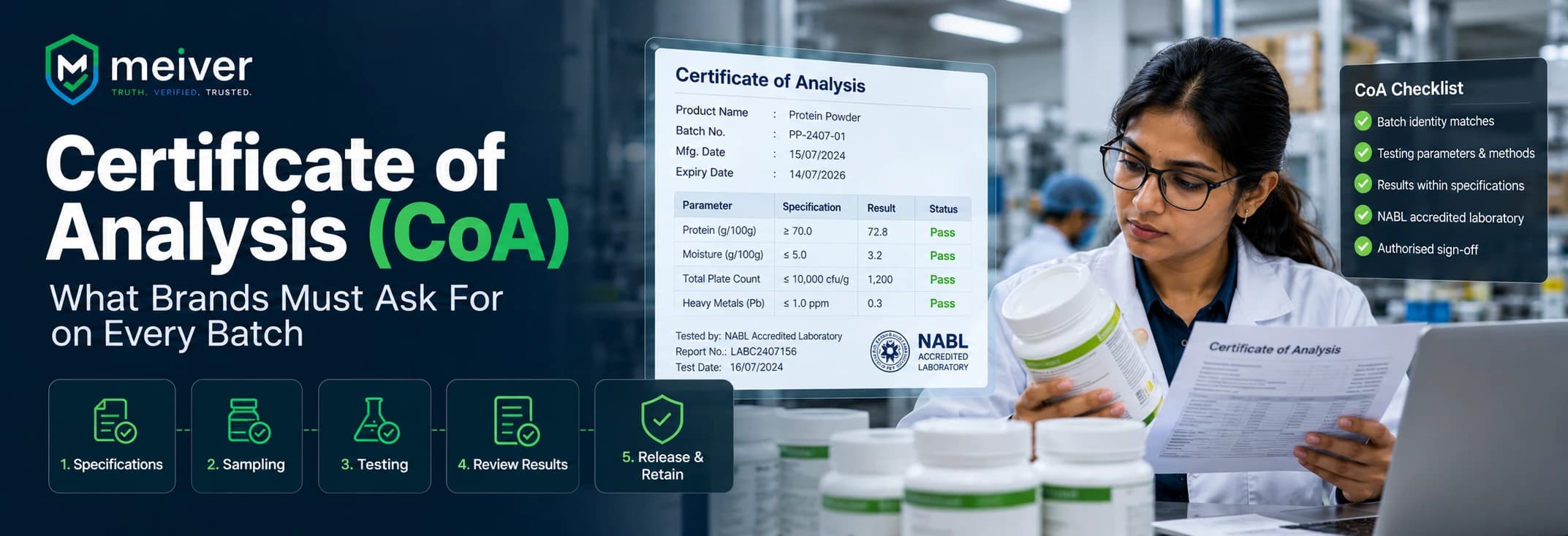
For example, a shopper scanning “lab-tested” protein powder could see the matching batch number, Certificate of Analysis (CoA), and an explanation of the reported tests. A report for another batch would undermine that experience.
4. A five-step FSSAI labelling checklist
Use this workflow before approving artwork or commissioning another packaging run.
Step | What the brand should do | Role of QR |
1 | Identify applicable FSSAI labelling provisions. | Establish the legal baseline first. |
2 | Confirm mandatory on-pack information. | Supplement it unless replacement is expressly permitted. |
3 | Separate retail and non-retail requirements. | Assess specific electronic-disclosure provisions. |
4 | Match batch records, CoAs and sourcing evidence. | Give access to relevant batch information. |
5 | Review readiness before 1 July 2027. | Align packaging and digital records. |
Assign responsibility across quality, packaging and marketing. Check printed samples and scan destinations together.
5. Turn information into useful transparency
People discovering a brand through search, a retailer listing or packaging should find consistent answers.
Publish educational content explaining your testing and sourcing, link relevant product pages, and make QR destinations easy to read on a phone.
Meiver supports batch-specific QR pages displaying product details, production journeys, linked CoAs and selected sourcing information. Brands choose what becomes public. This helps connect a packaging claim with its supporting records.
Conclusion
Use FSSAI labelling guidelines alongside the applicable regulations. Plan your review now, retain required declarations, and make every scan lead to evidence relevant to that product.
FAQs
When does this FSSAI notification take effect?
The amendment states 1 July 2027 as its commencement date.
Do FSSAI labelling requirements now mandate QR codes?
These documents do not create a universal mandate.
Are FSSAI labelling regulations identical for every supplement?
Review the product category, format and applicable supplement-specific provisions.
Where should brands check FSSAI guidelines on labelling of food products?
Use official FSSAI regulations, amendments and advisories; distinguish binding provisions from guidance.