A distributor calls about a suspicious batch. Your manufacturer has the test report, your warehouse has dispatch details, and customer complaints sit in WhatsApp. Who connects the dots?
For Indian brands and manufacturers, recall readiness starts before that call. This playbook covers food and nutraceutical products regulated as foods, from preparation through closure.
What Is Product Recall?
A product recall removes affected products from the supply chain, including consumers where necessary. For food, it addresses safety risks or non-compliance—not simply disappointing taste.
Under Section 28 of the Food Safety and Standards Act, an FBO with reason to believe its food is non-compliant must immediately initiate withdrawal procedures and inform competent authorities. Do not wait for conclusive laboratory results before taking protective action. The Food Recall Procedure Regulations, 2017 provide the detailed framework. fssai.gov.in
Illustrative product recall examples include undeclared allergens, contamination and incorrect labels with safety implications.
1. Prepare Before a Complaint Arrives
Assign a recall coordinator and backups across quality, manufacturing, logistics and customer support. Agree who contacts authorities, approves notices and coordinates returns.
Keep current manufacturer, distributor, marketplace and retailer contacts. Test your plan with a mock recall: can you connect an ingredient lot to finished batches and destinations? Record gaps and fix them.
2. Contain Stock and Investigate Scope
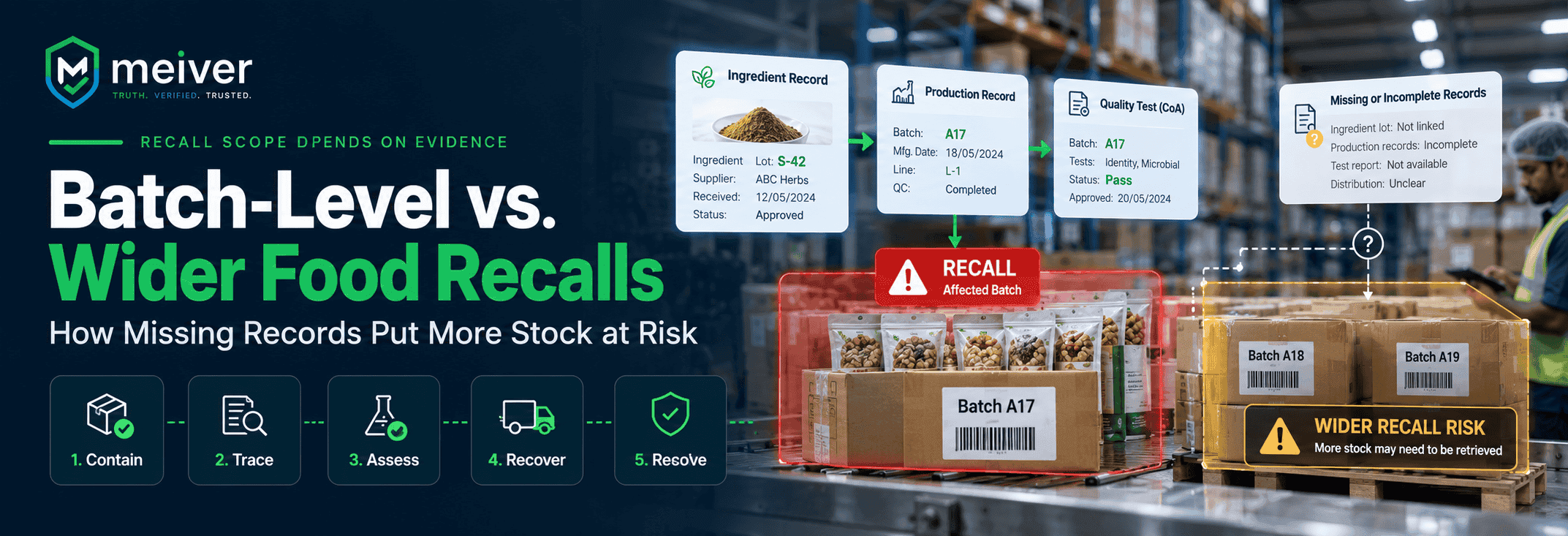
Stop affected dispatches, segregate stock and preserve relevant records. Ask your manufacturing partner for ingredient lots, production records, batch test reports and dispatch information.
One complaint does not automatically define the recall boundary. Shared ingredients or processing conditions may connect several batches. Scope must follow investigation findings and authority requirements; incomplete records can make a narrower recall difficult to justify.
3. Notify Authorities and People Clearly
Your food product recall procedure should identify regulatory contacts and communication responsibilities.
FSSAI’s order dated 18 March 2026 implemented recall functionality in FoSCoS. FBOs must enter recalls they initiate and record subsequent actions through their login. fssai.gov.in
Tell trade partners what to stop selling and affected consumers what to do. Include product photographs, batch numbers, relevant dates, the reason, return instructions and a contact. Use clear language and accessible updates across relevant channels.
4. Retrieve and Reconcile Every Quantity
Coordinate retrieval across distributors, retailers, marketplaces and consumers. Track quantities distributed, held, returned and otherwise accounted for.
Separate returned stock from saleable inventory. Document appropriate disposition, including destruction or permitted correction, following applicable requirements. A refund alone does not establish that affected food has left circulation.
5. Review Effectiveness and Close Properly
Check whether recipients acted, investigate causes and document corrective actions. Follow reporting and termination requirements; an internal “closed” status does not replace regulatory closure. FSSAI guidance provides for authority-issued written termination. fssai.gov.in
Product recall process: five-stage overview
Editorial summary; use the official procedure for detailed requirements.
Stage | Brand’s action | Evidence to maintain |
Prepare | Assign roles; test the plan | Contacts, procedures, mock-recall findings |
Contain and assess | Stop dispatches; investigate scope | Batch, ingredient, distribution records |
Notify | Inform authorities, partners, consumers | Submissions, notices, communication logs |
Retrieve and reconcile | Track returns; arrange disposition | Quantity reconciliation, disposition records |
Review and close | Check effectiveness; correct causes | Effectiveness checks, corrective actions |
Conclusion: Make Batch Evidence Usable
Product recall management software helps when records support real action. Meiver supports batch-specific recalls, consumer-page safety updates, notifications to people who scanned and subscribed, and an audit trail. It does not reach every purchaser, replace official reporting or retrieve stock. MeiverFeatureReference
Clear identification and actionable updates support trust; consumer safety comes first.
Explore how Meiver supports batch-specific recall records and consumer safety updates.
FAQs
What is product recall in pharma?
It removes affected medicines through drug-specific procedures. Refer to CDSCO’s 2024 Recall and Rapid Alert System guidelines, including biologicals and vaccines; food reporting procedures do not apply. cdsco.gov.in
Does product recall coverage insurance cover every cost?
No. Coverage depends on policy triggers, exclusions, limits and insured costs. Review the wording with your insurer.
What should a product recall email example include?
“Recall: [product], batch [number]. Please stop consuming it because [reason]. Follow [return/refund instructions]. Contact [details]. Updates: [link].” Adapt instructions to the actual risk.