A supplier flags a potentially contaminated ingredient. Your team stops dispatch, but one question remains: which finished packs contain it?
The answer may sit across purchase invoices, factory registers and messages from your contract manufacturer. Until those records connect, more stock may need to come off shelves.
That uncertainty explains why potentially unaffected products can enter a wider food recall. Calling them “good stock” before the investigation establishes their status, however, would be premature.
What Is Food Recall?
The food recall definition under FSSAI covers removing food from the market at any stage of the food chain, including food held by consumers. The practical food recall meaning is straightforward: retrieve implicated products and communicate what customers should do. fssai.gov.in
Under Section 28, an operator with reason to believe its food is non-compliant must immediately initiate withdrawal procedures and inform competent authorities. Protective action should not wait for conclusive laboratory results. fssai.gov.in
Batch-Level vs. Full Recall: Scope Matters
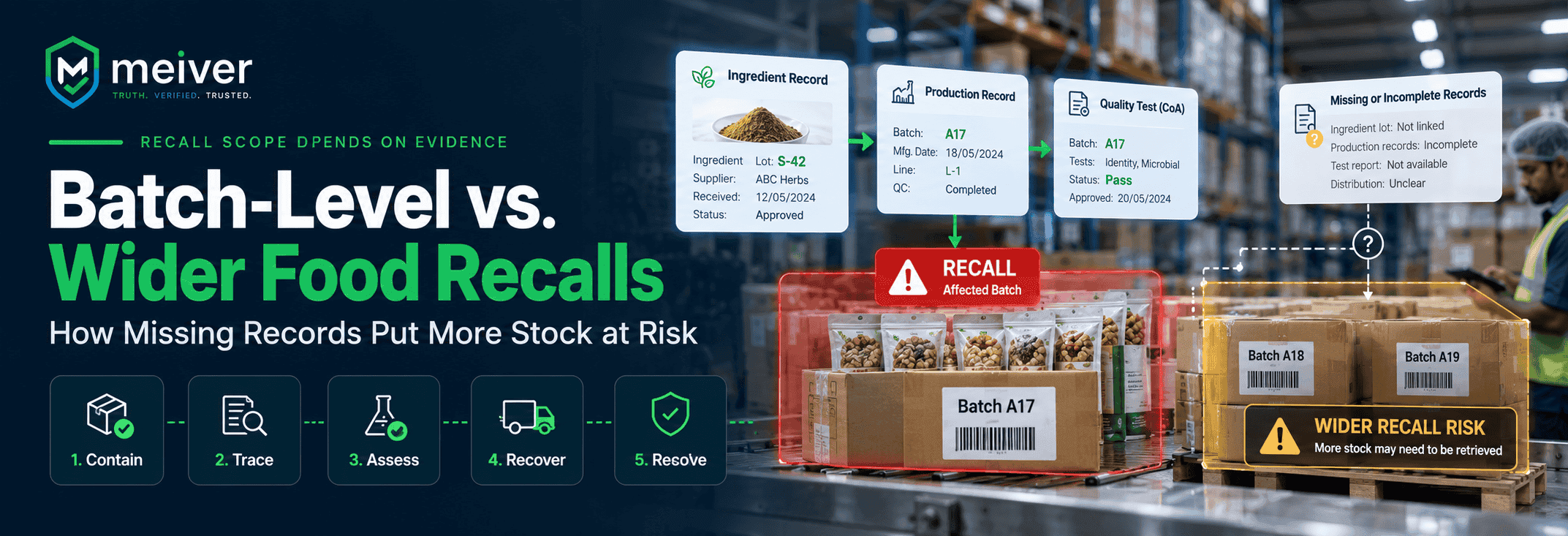
A batch-level recall targets identified production lots. Here, “full recall” means all batches of a particular product within the relevant period—not everything the brand sells.
These are practical descriptions of scope, rather than formal FSSAI classifications.
Reliable records can support a narrower scope when the investigation and authority requirements justify it. They cannot guarantee one: contaminated ingredients, shared equipment or processing failures may affect several batches.
Why Missing Records Put More Stock at Risk
Consider a hypothetical snack manufacturer using one seasoning lot across several production runs. If ingredient-use records identify those runs, investigators have a starting point. If records merely say “seasoning received this month,” the potentially affected period becomes harder to establish.
Common gaps include:
Supplier lot numbers missing from production records.
Rework added without recording its source batch.
Dispatch records that identify products but omit batch codes.
The operational consequence is uncertainty about which stock can reasonably be excluded. Wider retrieval can increase transport, storage, replacement and disposal costs—without proving every recovered pack was unsafe.
Recall Does Not Automatically Mean Destruction
Regulation 10 requires recovered food to be segregated, clearly labelled and accurately recorded.
Correction or reprocessing requires permission from the CEO of FSSAI. Otherwise, disposal must occur in consultation with that authority, with complete disposal records maintained. Testing alone does not authorise resale of recalled food. fssai.gov.in
The objective is a defensible safety decision. Saving stock must never override consumer protection.
A Food Recall Process Built Around Evidence
Your food recall plan should establish responsibilities, contacts and record access before an incident. Use this recall procedure to connect action with evidence.
Stage | Evidence to review | Decision supported |
Contain | Suspected products and available stock | Stop dispatch and segregate |
Trace | Ingredient lots and production history | Identify potentially affected batches |
Assess | Hazard investigation and relevant testing | Establish justified recall scope |
Recover | Distribution records and returned quantities | Retrieve and reconcile stock |
Resolve | Safety findings and authority directions | Permitted disposition and closure |
FSSAI’s 18 March 2026 order introduced recall reporting and subsequent-action recording through FoSCoS. Operators must use that reporting channel; commercial tools do not replace it. fssai.gov.in
How meiver Supports Food Recall Management
When evaluating food recall management software, ask whether your team can access the evidence behind each batch.
meiver connects batch records, production-stage evidence and quality documents with batch-specific recall notices and recall audit history. It supports evidence access and communication; it does not independently determine safety or guarantee smaller recalls. MeiverFeatureReference
Notifications reach consumers who previously scanned and subscribed. Broader communication remains necessary. Clear batch identification and actionable instructions help customers understand whether their pack is affected.
Conclusion
Recall preparedness starts before a complaint. Connected records help teams investigate scope, retrieve products and explain decisions.
Explore how meiver connects batch evidence and recall records to support a more informed response.
FAQs
What are food recall classes?
US FDA Classes I, II and III describe health-hazard severity, from serious potential harm to unlikely adverse health consequences. They do not describe batch quantities or FSSAI scope categories. FDA
Can excellent traceability prevent wider recalls?
No. It supports investigation, but hazards shared across batches can still require wider action.