What Is Milk Adulteration?
Milk adulteration means milk has been altered so it no longer matches what it is represented to be. Types of milk adulteration covered in FSSAI guidance include added water, starch, detergent, urea and other substances requiring different detection methods.
Food adulteration in milk can affect composition, quality and, depending on the adulterant, safety. Milk adulteration in India is therefore also an important quality-control issue for dairy brands.
3 Simple Milk Adulteration Tests at Home
1. Added water
Place one drop of milk on a clean, polished slanting surface. FSSAI's DART guidance says pure milk tends to stay or flow slowly while leaving a white trail. Milk diluted with water tends to move quickly without the same trail. FSSAI
This is only an indicative test; it cannot measure how much water is present.
2. Detergent
Take 5–10 ml of milk, add an equal amount of water and shake. Detergent-adulterated milk can form dense lather, while pure milk should form only a thin foam layer from agitation. FSSAI
3. Starch
For a simple FSSAI DART-style starch screen, add 2–3 drops of tincture of iodine to the milk sample. A blue colour indicates possible starch. FSSAI
Formal FSSAI analytical methods are separate laboratory procedures and should not be casually reproduced at home. FSSAI
Are Milk Adulteration Test Kits Reliable?
A milk adulteration test kit can simplify screening when designed for a specific adulterant. FSSAI's Food Safety Magic Box includes simple tests for water, urea, detergent and starch in milk.
However, not every milk adulteration testing kit has the same purpose or validation. Educational screening kits, validated rapid analytical methods and laboratory testing are not interchangeable. Check what a kit detects, follow its instructions exactly and do not treat a screening result as automatic laboratory confirmation.
What Dairy Brands Need Beyond a Home Test
A home test may raise a red flag. For a dairy brand, the bigger question is whether the exact pack can be connected to sourcing, production and quality evidence.
Testing generates the evidence. Traceability helps connect that evidence to the batch a consumer bought.
Stage | What the brand does | What it helps establish |
01. Source | Record approved supplier and incoming lot | Where the milk/input came from |
02. Test | Perform applicable quality checks | What was checked |
03. Record | Link results and documents to the batch | What evidence exists |
04. Verify | Review batch, CoA/test evidence and complaints | Faster investigation |
05. Build trust | Share appropriate verified information | Greater transparency |
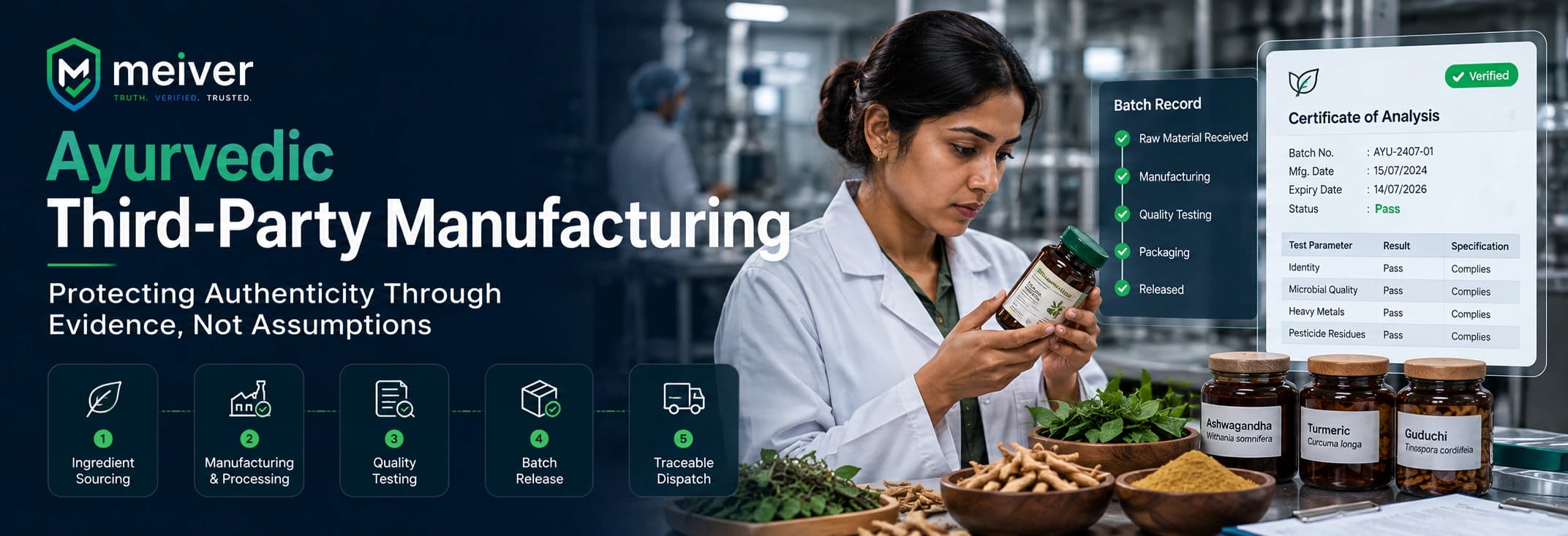
This is where Meiver becomes relevant—not as an adulteration detector, but by helping connect batch history, supporting documents, CoA records and consumer-facing verification information. Meiver's documented capabilities include batch management, CoAs, QR verification, recalls and analytics. AI Characters For Banners
Conclusion
Home screening can flag warning signs, but it does not replace proper testing. For manufacturers, trust comes from reliable sourcing, suitable testing, clear records and traceable batch evidence.
FAQs
1. How to check milk adulteration at home?
Use FSSAI-supported screening methods for suspected added water, detergent or starch. Treat the result as an indication, not final proof.
2. Can a milk adulteration test kit confirm adulteration?
Not always. Screening kits can flag concerns, while confirmatory or quantitative conclusions may require validated analytical methods or laboratory testing.
3. What are common types of milk adulteration?
Examples include added water, starch, detergent, urea and other substances listed in FSSAI testing guidance. Different adulterants need different methods.
4. Can the same method be used for a paneer adulteration test?
Not automatically. Paneer is a different product matrix, so the suitable method depends on the suspected adulterant. Use product-specific FSSAI guidance or appropriate laboratory testing.