A distributor reports a damaged strip. Your team asks the factory for batch details. Production records are scattered across emails. What happens next?
That is where pharmaceutical third party manufacturing needs more than a competitive quotation. Brand owners need dependable evidence, accessible when a product’s safety is questioned.
1. What is third party manufacturing in pharma?
It means outsourcing medicine production to an appropriately licensed manufacturer, often for sale under your brand. Pharmaceutical contract manufacturing can cover production, testing and packaging, with responsibilities defined in agreements.
Outsourcing does not remove accountability. Under India’s Drugs Rules, marketers share responsibility with manufacturers for drug quality and regulatory compliance. cdsco.gov.in
2. Verify licences and the actual manufacturing site
When assessing third party manufacturing pharma companies in India, check the manufacturing licence, relevant product permissions and dosage-form capabilities. Confirm which site will make your medicine.
Request evidence of applicable revised Schedule M compliance. Audit the facility rather than accepting a certificate or sales presentation as proof of everyday practice.
A search for “top 10 pharmaceutical third party manufacturing company in india” can start your shortlist. It cannot establish whether a factory is suitable for your particular product.
3. Agree on quality responsibilities before production
For third party manufacturing in pharma, require a written quality agreement covering:
Approved specifications, testing responsibilities and authorised batch release.
Access to records, audit rights and notification of deviations.
Approval of supplier, process, site or packaging changes.
Complaint investigations, recall coordination and subcontracting controls.
Schedule M requires contract givers to assess outsourced records and results, and manufacturers must hold valid licences. cdsco.gov.in
4. Demand batch-specific evidence
Medicine third party manufacturing should provide more than a generic “tested” statement. Ask for a batch-linked Certificate of Analysis showing specifications, results and approval, alongside access to supporting records.
Have qualified quality personnel assess:
Raw-material identity and supplier qualification.
Manufacturing and packaging records, including reconciliation.
Relevant finished-product tests, such as assay, impurities and dissolution.
Microbiological or sterility controls where applicable.
Stability evidence supporting shelf life and storage conditions.
Tests depend on the medicine and approved specifications. WHO’s GMP guidance addresses controlled manufacturing, quality control, validation and complaint handling. who.int
5. Make recall readiness part of supplier selection
In contract manufacturing in the pharma industry arrangements, ask a practical question: “Can we identify this batch’s materials, release evidence and distribution destinations quickly?”
Conduct a mock recall together. Agree who investigates, who communicates and how stock is located. For third-party manufacturing partnerships in India, clear handovers between factory, brand and distributors matter as much as dispatch speed.
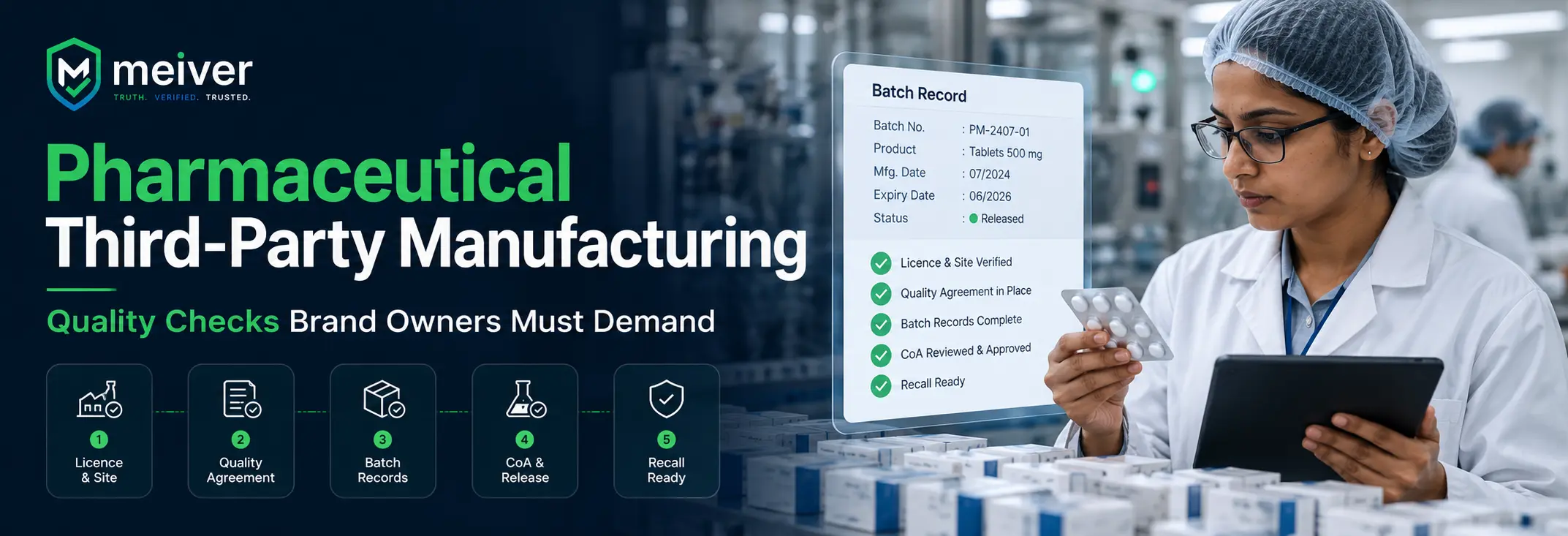
Process infographic: Five quality checkpoints
Process step | Evidence to demand | Brand control gained |
1. Qualify manufacturer | Licence, permissions, site audit | Confirm production suitability |
2. Agree responsibilities | Signed quality agreement | Clarify decisions and accountability |
3. Monitor production | Material and batch records | Review changes and deviations |
4. Review release | Batch CoA and release approval | Confirm documented acceptance |
5. Prepare recall | Distribution records and mock recall | Locate affected stock |
Conclusion: Keep the evidence connected
Meiver’s traceability features connect batch records, production stages, Certificates of Analysis and recall information. That helps teams retrieve the story behind a product when questions arise. meiver.io
For medicine workflows, establish pharmaceutical validation and regulatory suitability separately. Traceability supports oversight; it does not replace GMP or qualified release decisions.
Explore Meiver to discuss your batch visibility needs.
FAQs
Are loan license and third party manufacturing the same?
No. A loan licence is a regulatory licence to use another licensee’s manufacturing facilities. Third-party manufacturing describes an outsourcing arrangement; confirm the applicable licensing route with the licensing authority. cdsco.gov.in
Is a CoA enough to approve a manufacturer?
No. Review site capability, quality systems, supporting records and recall readiness too.