White-label manufacturing helps food, beverage and nutraceutical brands launch products without building their own factory. The model itself is not unsafe. The risk begins when a brand owns the customer promise but cannot prove how its product was made, tested or controlled.
FSSAI’s FoSCoS framework explicitly includes contract manufacturers and contract packers within food manufacturing/processing activity. Outsourced production is therefore part of India’s regulated food ecosystem. FSSAI Foscos
What Are White Label Products?
White label products are manufacturer-developed products supplied to other brands, usually with limited customisation. Common white label products examples include protein powders, nutrition mixes, packaged snacks, beverages and food-regulated supplements.
If you are searching “what is white label products”, the practical answer is simple: one company manufactures the product while another sells it under its own brand.
The white label products meaning also differs from private label in common commercial usage. White label usually refers to an existing product offered to multiple brands; private label usually refers to a product made for one retailer or brand, often to its specifications.
However, white label products vs private label is not a dependable legal classification under FSSAI. What matters more is the actual role of each Food Business Operator.
Where the Hidden Quality Risk Appears
For brands sourcing white label products India-wide, the real issue is visibility.
Can you verify who made this batch? Was the approved specification used? Does the Certificate of Analysis actually correspond to this batch? Were ingredient, formulation, process or packaging changes authorised?
FSSAI states that licensed FBOs must maintain documented food-safety management systems and comply with applicable Schedule 4 requirements covering GMP and GHP. FSSAI
Beyond regulation, supplier qualification, approved specifications, change control and batch-specific evidence are sensible brand controls. They should not, however, all be presented as universal legal requirements.
What Evidence Should Brands Ask For?
Before choosing white label products suppliers or a white label products manufacturer in India, ask for evidence—not simply samples, MOQ and pricing.
Check licensing and manufacturing scope, approved product specifications, supplier and ingredient records, relevant QC/testing evidence, batch-linked CoAs, change-control procedures and recall readiness.
A reliable white label products manufacturer should be able to connect a finished batch to the records that explain how it was produced and released.
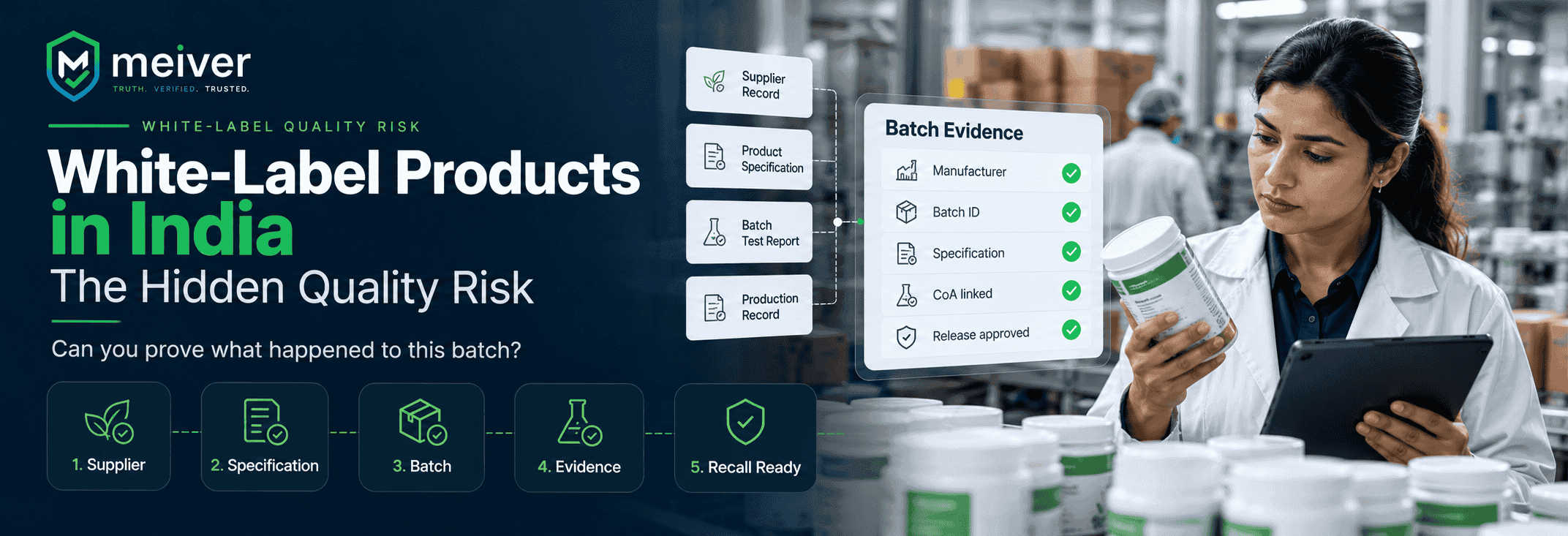
Process Infographic: From Supplier to Traceable Product
Process Stage | Brand Question | Evidence to Keep |
1. Supplier selected | Who will actually manufacture it? | FSSAI licence, facility scope, supplier approval |
2. Specification approved | What exactly was agreed? | Formula/specification, packaging, claims |
3. Batch produced | Was the agreed process followed? | Batch code, production and QC records |
4. Evidence verified | Does the testing match this batch? | CoA, lab report, release evidence |
5. Product sold | Can we trace it if something goes wrong? | Distribution, complaint and recall records |
Why Batch-Level Traceability Matters
FSSAI's Food Recall Procedure Regulations require food businesses to maintain distribution records covering details such as suppliers, customers, lot numbers, batch codes and relevant product dates. FSSAI
That matters when a customer complains, a test fails or a recall becomes necessary. The question quickly changes from “Is our product safe?” to “Which exact batches are affected, and where did they go?”
This is where Meiver becomes relevant.
Meiver does not choose or qualify your manufacturer. It helps organise product, batch, production-stage, quality-document and traceability evidence once outsourced manufacturing begins. Its batch model can link supporting documents such as lab reports and supplier certificates while preserving batch history and approvals. MeiverFeatureReference Meiver can also structure batch-level CoA results while retaining the original laboratory document. MeiverFeatureReference
Internal-link opportunities: Batch & Stages Management, Certificate of Analysis, and Recall Management. These are already core parts of Meiver's planned site structure. Meiver Page Structure
How to Find White Label Products Without Buying Blind
When researching how to find white label products, evaluate manufacturers on traceability as well as taste, MOQ and price.
Ask one simple question:
“Can you prove what happened to this batch?”
If the answer is spread across WhatsApp messages, spreadsheets and disconnected PDFs, the visibility gap is already clear.
Conclusion
Outsourcing manufacturing does not outsource brand accountability.
For brands selling white-label food and nutraceutical products, the safer operating model is to treat every supplier, specification and batch as something that must be evidenced—not merely trusted.
That is increasingly important because the brand owner's identity remains relevant even when it is not itself the manufacturer, marketer, packer or bottler. FSSAI's labelling rules expressly recognise that situation. FSSAI
FAQs
1. Are white label products legal in India?
Yes. White-label production can operate within India's food regulatory framework, provided the relevant businesses, products, labels and activities comply with applicable FSSAI requirements.
2. Does FSSAI require a CoA for every white-label batch?
Not as a universal rule for every food product. Testing requirements depend on the product and regulatory context. A batch-specific CoA can nevertheless be an important quality-control and procurement practice.
3. Does the brand owner still matter if another company manufactures the product?
Yes. FSSAI's labelling rules specifically recognise the brand owner even when it is not itself the manufacturer, marketer, packer or bottler. FSSAI
4. What should brands check first in a white-label manufacturer?
Start with licensing, manufacturing capability, agreed specifications, food-safety controls, testing evidence, change control and batch traceability.