SAP Can Trace a Batch. But Can Your Customer Understand the Evidence?
For a manufacturer, a batch is more than a lot number. It connects raw materials, production, quality checks, finished goods and distribution.
SAP handles much of this extremely well.
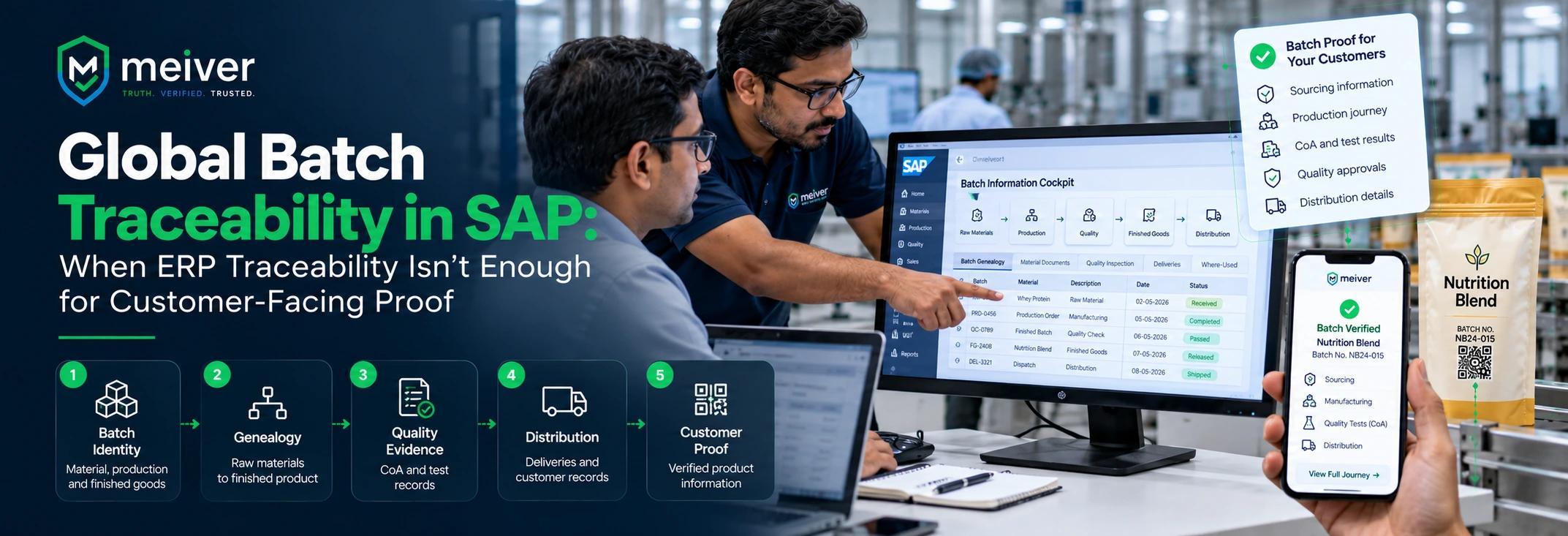
SAP Global Batch Traceability (SAP GBT) can trace tracked objects across SAP and non-SAP systems, analyse batches top-down or bottom-up and support distribution and recall investigations. SAP Help Portal SAP's Batch Information Cockpit can also trace finished products back to raw-material batches and expose related suppliers, purchase orders, deliveries and quality inspection results. SAP Help Portal
So the problem isn't that SAP cannot trace a product.
The harder question is:
Can the right person outside your ERP quickly understand and verify the evidence behind that product?
That distinction matters increasingly for food, beverage, nutraceutical and D2C brands.
What Global Batch Traceability in SAP Actually Does
Think of a protein-powder batch.
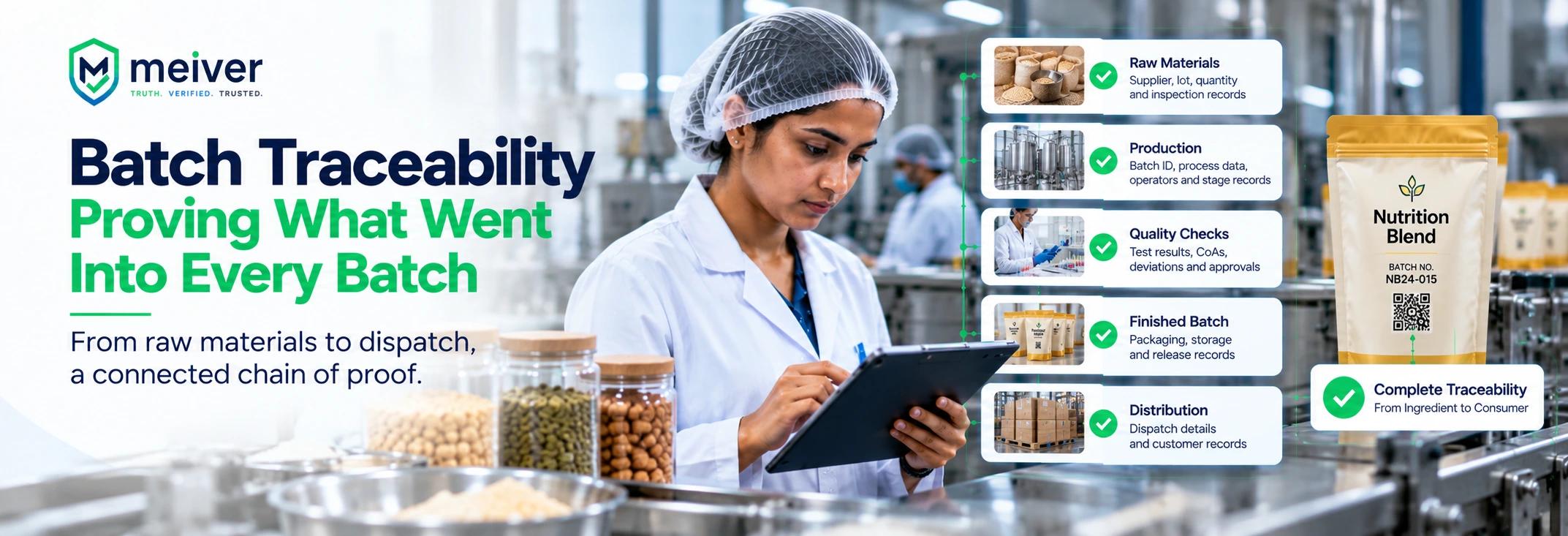
Raw-material lots arrive. Materials enter production. A finished batch is created. Quality checks are performed. Stock moves to distribution.
With batch traceability SAP workflows, those relationships can be connected through batch masters, material documents, production orders and sales records. SAP's Batch Information Cockpit supports both top-down and bottom-up where-used analysis and access to underlying business documents. SAP Help Portal
SAP can also support quality information. This is why treating global batch traceability SAP as merely transactional would be misleading.
The opportunity sits elsewhere: turning selected enterprise evidence into something simpler and externally usable.
ERP Evidence and Product Proof Are Not the Same Experience
A QA team may be comfortable navigating production records, inspection lots and a certificate of analysis SAP workflow.
A retailer, distributor or consumer usually is not.
They may simply want answers:
Which batch is this?
Where did it come from?
Was this specific batch tested?
What does its CoA show?
Is there supporting evidence?
Has this batch been recalled?
The data may already exist internally. The friction comes from accessibility, context and presentation.
That is the gap between maintaining a sophisticated batch manufacturing record in SAP and creating an understandable product-trust experience.
Process Infographic: From ERP Record to Verifiable Product Evidence
Process Layer | SAP / ERP Role | Customer-Facing Proof Opportunity |
1. Batch identity | Maintain batch master, material and production relationships | Present the exact batch identity clearly |
2. Genealogy | Trace raw materials → production → finished goods | Turn complex genealogy into a simple product journey |
3. Quality evidence | Store inspection results, characteristics and quality records | Connect the relevant CoA and supporting evidence |
4. Distribution | Track delivery and customer relationships | Give authorised users understandable batch verification |
5. Post-sale trust | Support enterprise operational workflows | Make approved evidence accessible through QR verification |
Where Meiver Fits Alongside an ERP
Meiver is not positioned as an SAP replacement.
It is designed as a batch-level product-trust layer for brands. Its platform connects batches to production stages, approvals, supporting documents and CoA information, then uses that controlled data to power consumer-facing QR verification. MeiverFeatureReference
Its CoA capability structures test parameters and results while retaining the original laboratory document, helping convert a static quality file into batch-specific evidence. MeiverFeatureReference
That changes the role of a batch record management system. Instead of the record ending inside operations, approved information can become a trust touchpoint.
For brands already searching for a batch record tracker, SAP master batch record capability or batch record issuance management system, the useful question is therefore not, “Should we replace our ERP?”
It is:
Who needs to verify this batch, and how quickly can they understand the proof?
Why This Matters More for Modern Brands
Consumers increasingly encounter products through marketplaces, quick commerce, social media and D2C websites before they ever speak to the manufacturer.
A generic QR code leading to another marketing page adds little confidence.
Meiver's approach is to let a batch-specific QR expose selected product journey, batch and lab information without requiring the consumer to understand the systems behind it. Its product architecture explicitly connects internal batch records with public scan-to-verify experiences. MeiverFeatureReference
That is especially relevant for brands making claims around testing, sourcing, authenticity or manufacturing quality.
Conclusion: Don't Replace the Record. Make the Evidence Usable.
Global batch traceability in SAP can be sophisticated. The opportunity for brands is not to duplicate that capability.
It is to make approved batch and quality evidence understandable to the people who cannot—or should not—enter the ERP.
That could mean a buyer checking a batch, a QA team sharing a CoA, or a customer scanning a pack.
See how Meiver turns connected batch and quality records into verifiable product evidence.
Suggested internal links:
Traceability → Batch & Stages Management → CoA → Consumer QR Verify
FAQs
1. Does SAP support global batch traceability?
Yes. SAP Global Batch Traceability supports top-down and bottom-up analysis of tracked objects across SAP and non-SAP environments and can assist distribution and recall analysis. SAP Help Portal
2. Can SAP store quality information and CoAs?
SAP can support quality inspection information and quality-related documentation. The limitation discussed here is not SAP's ability to hold quality data; it is how selected evidence is made accessible and understandable to external audiences.
3. What is the difference between batch traceability software and a batch record tracker?
Batch traceability typically focuses on relationships across materials, production and distribution. A broader batch record tracker may also organise stages, documents, approvals, testing evidence and lifecycle information.
4. Does Meiver integrate directly with SAP?
Meiver can operate alongside ERP environments, but its current product documentation does not document a native SAP connector. Custom integrations are available at the Enterprise level, so SAP-specific integration should only be claimed when separately implemented and confirmed. MeiverPricingPlanGuide