A batch number identifies a production run. It does not, by itself, prove what went into that run, what happened during production, why the product was released, or where it went.
Batch traceability is the ability to connect a finished batch to the raw-material lots used, production events, quality evidence and downstream movement associated with it. For food and nutraceutical manufacturers, that linked evidence matters during quality checks, buyer requests, complaints and recalls.
What Does Batch Traceability Mean?
The meaning of traceability in manufacturing is simple: being able to follow a product and its evidence backward and forward.
Good manufacturing traceability should help answer: Which supplier lot was used? In what quantity? Which production run received it? Who performed key stages? What process data was recorded? Which CoA or test result supported release? Where did the finished batch go?
GS1 frames traceability around Critical Tracking Events such as receiving, transforming, packing and shipping, supported by Key Data Elements describing who, what, where, when and why. GS1 also specifies that manufacturing inputs and outputs should be recorded at batch/lot level to maintain traceability. GS1
Why a Batch Number Alone Is Not Enough
In many brands, the evidence already exists—but across registers, spreadsheets, emails and PDFs. The difficulty starts when QA or operations must reconstruct one batch quickly.
For Indian food businesses, FSSAI requires distribution records to capture information including suppliers and customers, lot number, batch code, pack size, manufacturing date and expiry or best-before details. FSSAI FSSAI also implemented Food Recall functionality in FoSCoS in March 2026, requiring FBO-initiated recalls and subsequent actions to be recorded through FoSCoS. FSSAI
What Should Be Connected to Every Batch?
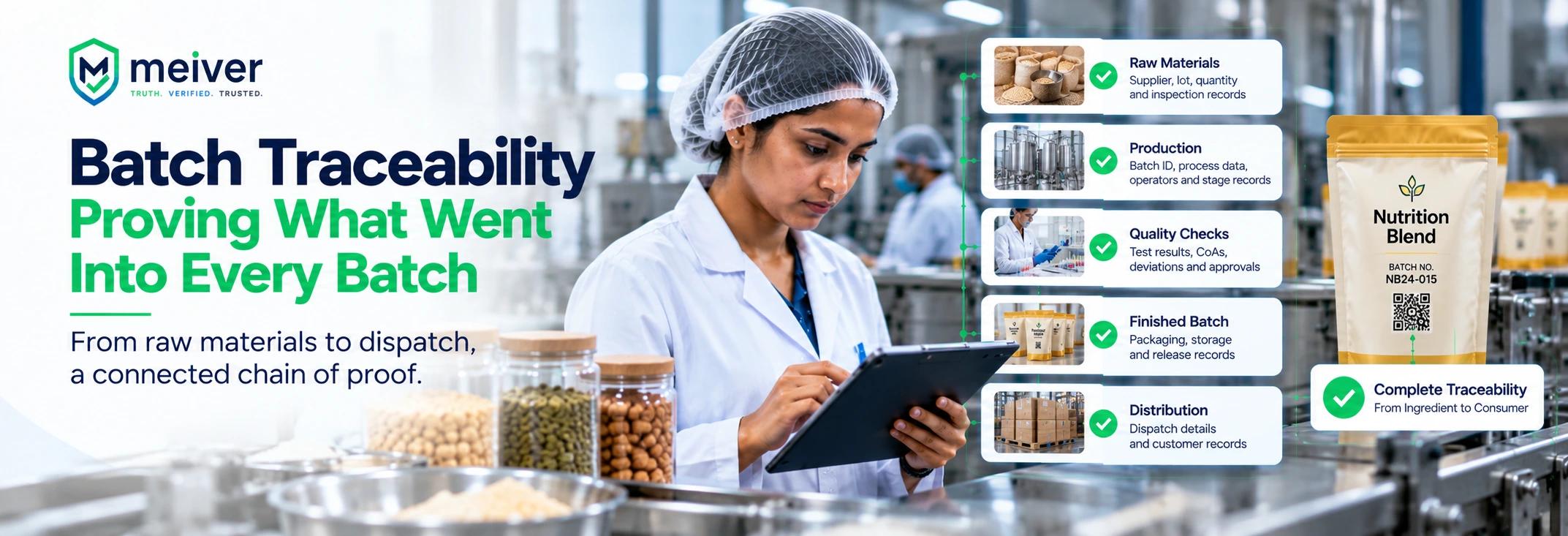
A useful batch record creates one evidence chain from incoming material to outgoing product: supplier lots, quantities, production stages, operators, process conditions, deviations, approvals, CoAs, packaging and distribution records.
The exact regulatory requirements differ by sector. The principle does not: evidence is more useful when it is linked to the batch it supports.
Process Infographic: From Input to Finished Batch
Stage | What gets recorded | What it proves |
Raw material received | Supplier, material lot, quantity, date | Which inputs entered production |
Batch created | Product/SKU, batch ID, planned quantity | Which production run they belong to |
Production stages recorded | Operators, timestamps, process data | What happened during manufacture |
Quality evidence linked | Checks, CoA results, deviations, approvals | Why the batch was released |
Finished batch traced | Packaging, storage, distribution | Where it went and what can be recalled |
From Compliance Record to Product Trust
Traceability is more valuable when it helps teams act, not merely pass an audit. Connected evidence can support faster complaint investigation and more precise recall decisions.
Meiver follows this connected-batch approach. Its batch records can link products, supporting documents, comments and approvals, while its production stages can capture who performed an activity, when, where and relevant process data. MeiverFeatureReference Meiver can also connect structured batch-specific CoA results with the original laboratory documents. MeiverFeatureReference
See how Meiver connects batch records, quality evidence and product verification.
Conclusion
A batch number is an identifier. Real traceability is the proof chain behind it: what came in, what happened, what evidence supported release and where the finished batch went.
When those records stay connected, batch traceability becomes useful long before something goes wrong—and critical when it does.
FAQs
What is batch traceability?
Batch traceability is the ability to trace a production batch backward to its inputs and production evidence, and forward to finished goods and downstream movement.
What does traceability mean in simple terms?
Whether someone searches traceability meaning in Hindi, traceability meaning in Tamil, traceability meaning in Marathi, traceability meaning in Telugu or traceability meaning in Malayalam, the operational idea is the same: knowing where something came from, what happened to it and where it went.
What should a batch traceability record contain?
It should contain enough linked evidence to reconstruct the batch, including relevant material lots, quantities, production stages, quality records, approvals and distribution details.
How is pharma batch traceability software different?
Pharma batch traceability software may need more tightly controlled manufacturing, review and audit records because pharmaceutical GMP requirements differ from food regulations. The core principle of linking batch-specific inputs, events, evidence and outputs remains the same.