A recall becomes difficult when the first 20 minutes are spent searching spreadsheets, production records, warehouse reports and distributor contacts.
A mock recall tests whether your team can answer three questions quickly: What went into this batch? Where did the batch go? How much can we account for?
For this exercise, one hour is a useful internal stress-test target. It is not an FSSAI statutory deadline. India’s Food Recall Procedure Regulations, 2017 define recall, traceability and recall responsibilities, but do not prescribe a universal 60-minute mock-recall requirement. FSSAI
What Is Mock Recall in the Food Industry?
A mock recall is a simulated product-recall exercise. Instead of removing an unsafe product from the market, the team selects a hypothetical problem and tests whether existing records can trace the affected product backward to its inputs and forward to its destinations.
The objective is not to prove that a product is unsafe. It is to expose weaknesses before a real recall does.
For food and FSSAI-regulated nutraceutical brands, useful success measures include:
time taken → percentage of quantity reconciled → missing records or contacts → corrective action required
Run the Mock Recall: The Five-Stage Test
Start without advance warning to the operational team. Select one realistic batch and start the clock.
Stage | What to do | Success measure |
01. Trigger | Select a hypothetical batch/problem | Team begins with a clearly defined scope |
02. Trace backward | Identify supplier and raw-material lots | Relevant inputs are located quickly |
03. Trace batch | Retrieve production, QC and batch records | Batch history can be reconstructed |
04. Trace forward | Identify warehouse stock and dispatch destinations | Affected quantities and locations are identified |
05. Reconcile & improve | Balance quantities and record gaps/CAPA | 100% reconciliation or documented exceptions |
The final figure matters. If 10,000 units were produced, your records should explain where those 10,000 units are—or clearly identify the exception requiring investigation.
Food Mock Recall Example
Imagine Batch PN2409 of a packaged nutrition product may contain an undeclared allergen.
The team starts at 10:00 AM. It identifies the relevant ingredient lot, checks which finished batch used it, retrieves PN2409 production and quality records, finds remaining warehouse stock, identifies distributor and D2C dispatches, and reconciles the total manufactured quantity.
The valuable result is not simply “completed in 48 minutes.”
It is knowing whether the business could reconstruct the product journey without relying on one employee’s memory, disconnected files or phone calls to multiple departments.
What Should Your Mock-Recall Record Capture?
A practical food traceability exercise template should make the result measurable.
Field | Example |
Recall scenario | Undeclared allergen in PN2409 |
Trigger time | 10:00 AM |
Raw-material lot identified | Yes / time found |
Affected quantity | Produced / held / dispatched |
Distribution identified | Warehouse, distributor, D2C |
Quantity reconciled | % accounted for |
Gaps found | Missing record/contact/mismatch |
CAPA | Action, owner, due date |
Exercise time | XX minutes |
A food safety food traceability template should be supported by clear product recall policy wording covering roles, escalation authority, communications, recordkeeping and corrective actions—not copied from a generic policy.
What About FSSC 22000 Mock Recall Requirements?
For FSSC 22000-certified organisations, mock recalls help demonstrate that recall arrangements work in practice. Version 7 was published in May 2026, and its audit-report requirements ask auditors to establish whether an effective recall system exists and record details of the last mock recall and its effectiveness. It does not create a universal one-hour rule. FSSC
From Traceability Records to Recall Readiness
A mock recall exposes the operational difference between having records and being able to use them quickly.
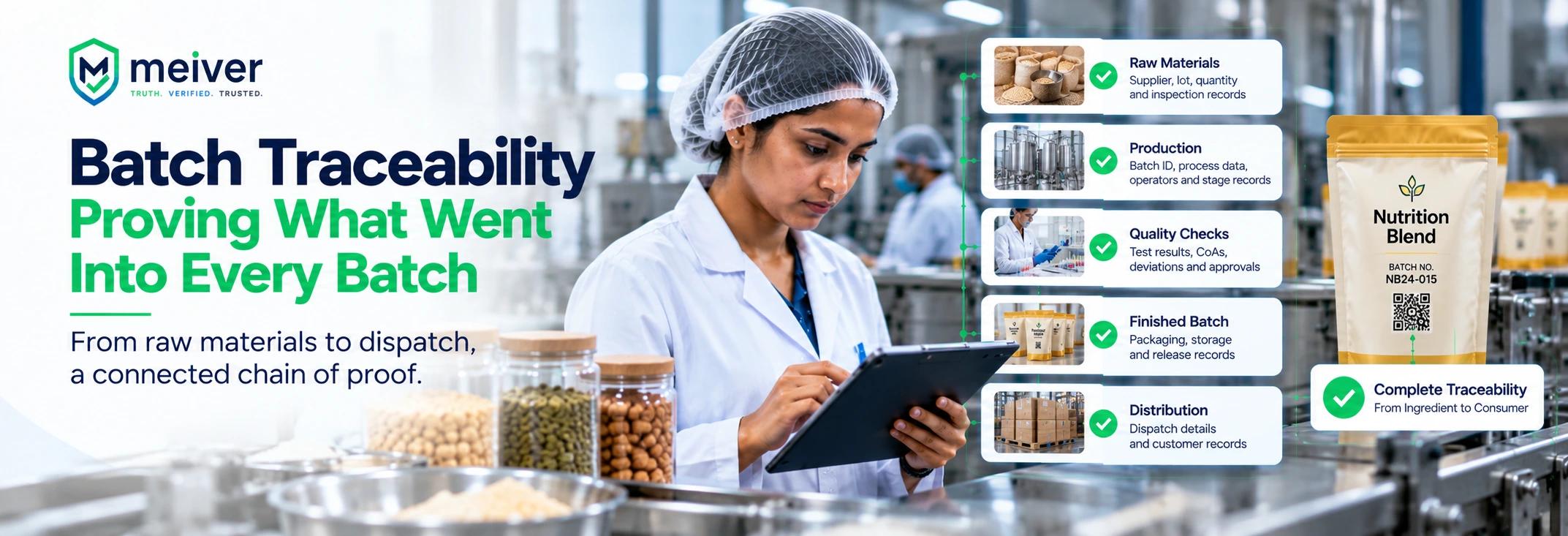
Meiver’s documented capabilities connect traceability, batch information, CoAs, recall management and analytics—supporting the type of evidence chain brands need when investigating a batch issue. Skills - Blog Writing Framework…
The goal is not to replace your food-safety process. It is to reduce the time spent hunting for the evidence that process depends on.
Conclusion
A strong mock recall is not a rehearsal for panic. It is a controlled test of how quickly your organisation can reconstruct a batch journey.
Set a realistic scenario. Start the clock. Trace backward. Trace forward. Reconcile the quantity. Record every gap.
If the exercise cannot produce reliable answers within your internal target, that failure is useful—it tells you exactly where traceability needs strengthening before a real recall puts the system under pressure.
FAQs
1. What is mock recall in food industry?
It is a simulated recall used to test whether a food business can identify affected batches, trace inputs, locate distributed product, reconcile quantities and document actions without conducting an actual market recall.
2. What should a food traceability exercise template include?
Include the scenario, batch/lot, trigger time, input lots, production records, stock locations, distribution destinations, quantities, reconciliation percentage, gaps, CAPA owner and completion time.
3. Do CDSCO guidelines for mock recall apply to food manufacturers?
Not to ordinary FSSAI-regulated food products. CDSCO’s 2024 recall guidance covers drugs, including biologicals and vaccines. Its mock-recall requirements should therefore not be presented as FSSAI food rules. CDSCO
4. Is there an official food recall database in India?
FSSAI implemented Food Recall functionality in FoSCoS on 18 March 2026. FBO-initiated recalls and subsequent actions are recorded through FoSCoS, while recall information is accessible to stakeholders and consumers through the portal.