A leaking pouch, unusual odour or “this tastes different” message can be more than a customer-service issue. It may signal a production, packaging, storage or safety problem. Good customer complaint handling starts by connecting the complaint to the correct SKU and batch—not by guessing the cause.
FSSAI guidance says FBOs receiving complaints through FoSCoS should conduct root cause analysis and, for genuine complaints, take Corrective and Preventive Action (CAPA). Not every complaint becomes a recall; teams must triage, assess risk and investigate with evidence. FSSAI
Why the Batch Comes Before the “Why”
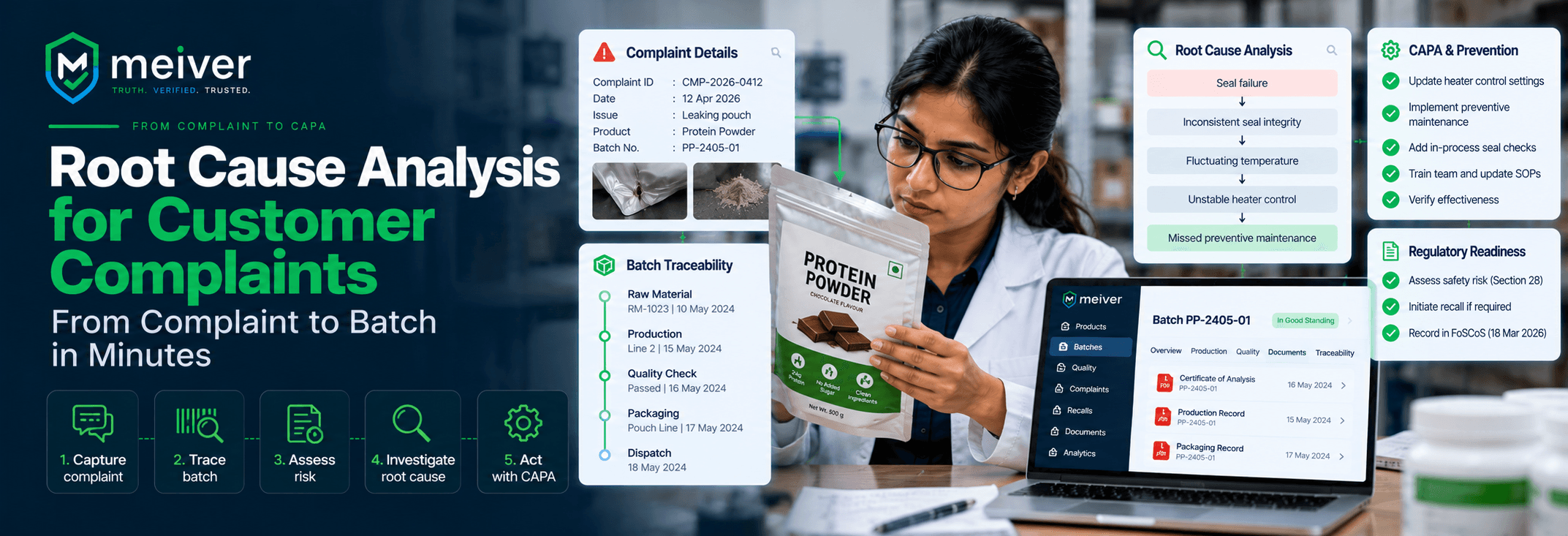
Root cause analysis in quality becomes easier when teams can quickly answer: Which product? Which lot? When was it made? Which production stages, QC checks and CoA belong to it?
Finding the batch is only the start. Traceability answers “what happened to this batch?” RCA asks “why?” Causes may lie in materials, equipment, packaging, transport or storage.
Meiver can connect SKUs, production stages, documents, comments, approvals and change history, giving teams a structured evidence trail. MeiverFeatureReference
Root Cause Analysis Steps: Complaint to CAPA
Step | Action | Evidence / Outcome |
1. Capture | Record complaint, photos, date and product details | Clear complaint record |
2. Trace | Identify SKU, batch/lot and production run | Correct batch located |
3. Assess | Check safety and regulatory risk | Containment or escalation decision |
4. Investigate | Review QC, CoA, packaging and stage records | Evidence for likely causes |
5. Act | Confirm cause, define CAPA and check effectiveness | Closure and prevention plan |
Which Root Cause Analysis Tools Work Best?
Two practical root cause analysis tools are the 5 why root cause analysis and the fish bone diagram for root cause analysis. The first drills toward an underlying process failure; the second organises possible causes under Material, Method, Machine, People, Measurement and Environment.
One of the simplest root cause analysis examples is pouch leakage:
Seal failure → inconsistent seal integrity → fluctuating temperature → unstable heater control → missed preventive maintenance.
It remains a hypothesis until records or testing support the conclusion.
What Should a Root Cause Analysis Form Capture?
A useful root cause analysis form records the complaint ID, product, SKU/batch, complaint description, photos or sample details, immediate containment, risk assessment, evidence reviewed, suspected and confirmed causes, CAPA, owner, due date and effectiveness check.
A repeatable root cause analysis template makes investigations consistent and helps reveal recurring failures.
When Does a Complaint Become a Recall Issue?
A complaint should not automatically trigger a recall. However, if an FBO has reason to believe food is non-compliant, Section 28 requires withdrawal procedures to begin while investigation continues. FSSAI
Since 18 March 2026, FBO-initiated food recalls and subsequent actions must also be recorded through FoSCoS. FSSAI
The key rule: do not wait for a perfect RCA before acting on a credible safety risk.
Where Meiver Fits
Meiver does not “find the root cause in minutes.” It helps teams reach relevant batch evidence faster. Batch and stage records, linked documents and CoAs can support investigation; if an issue escalates, recall management can apply to identified batches. MeiverFeatureReference
QR-enabled consumer pages can also expose batch, production journey and linked CoA information when a brand chooses to make it public. MeiverFeatureReference
Conclusion
Strong complaint investigation moves from traceability to evidence-based RCA and CAPA. The faster a brand can connect a complaint to the correct batch, the sooner it can protect consumers, resolve genuine issues and prevent recurrence.
FAQs
1. What is root cause analysis for customer complaints?
It is a structured investigation to determine why a complaint occurred and how to prevent recurrence.
2. Is 5 Whys mandatory under FSSAI?
No. FSSAI expects RCA and CAPA in relevant complaint handling, but 5 Whys is a practical method, not a mandated one. FSSAI
3. Does every food complaint require a recall?
No. Complaints require triage; recall action depends on the evidence and risk.
4. Can traceability software prove the root cause?
No. It can retrieve batch evidence faster; the quality team must still verify the cause.
Recommended internal links: Batch and Stages Management, Certificate of Analysis, Recall Management, and Consumer QR Verify. These align directly with Meiver’s planned website structure.