You already paid to print a QR code on the pack. The question is: what job is it doing?
Many food brands use QR codes for Instagram, WhatsApp or campaigns. That can be useful. But when a shopper wants to know the batch, source or evidence behind a “lab-tested” claim, social content cannot answer the same questions.
A QR code is not proof. It is the doorway to proof.
From Marketing QR to Verification QR
Think of QR code food packaging as a progression:
marketing QR → product-information QR → batch-linked verification QR
The first creates engagement. The second explains the product. The third connects the scan to product- or batch-linked evidence.
FSSAI has encouraged QR codes for accessible food information such as ingredients, nutrition, allergens and date information, while stating that QR information does not replace mandatory physical labelling. FSSAI GS1 Digital Link also supports product identification alongside batch, expiry and manufacturing details. GS1 India
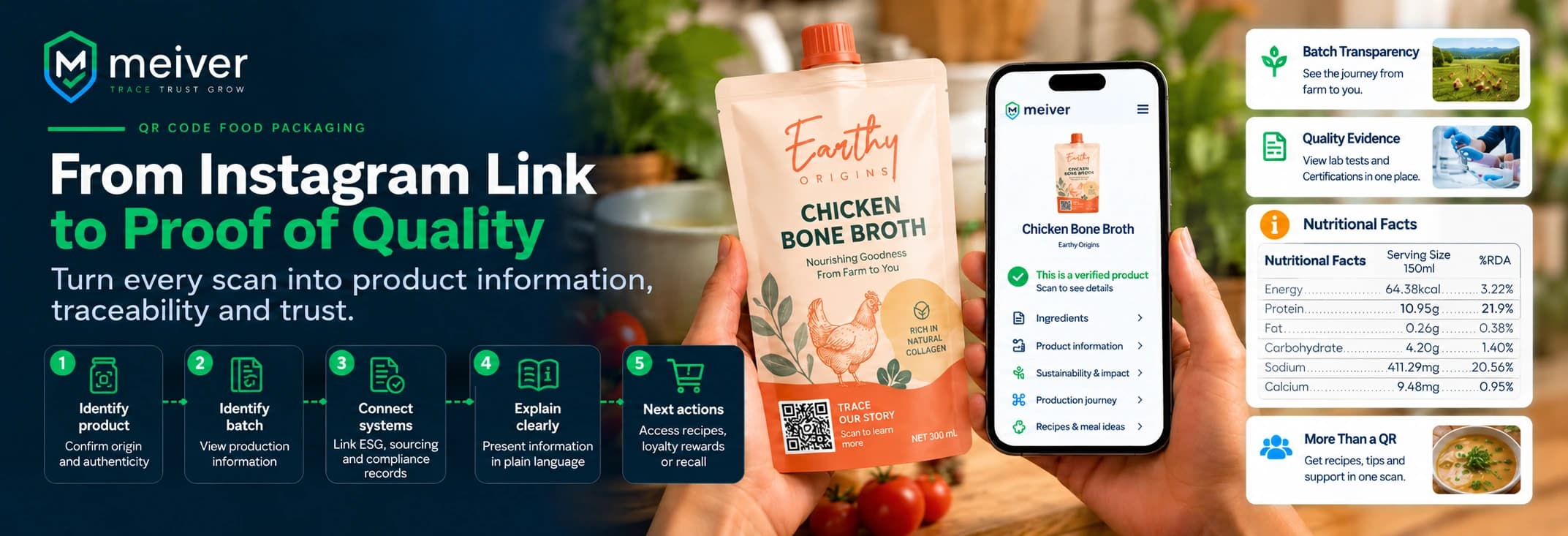
What Should Happen After the Scan?
Stage | QR Role | Customer Value |
1. Identify product | Connect to the correct SKU | Confirms what they are viewing |
2. Identify batch | Show lot/batch information | Adds production-run context |
3. Connect evidence | Link suitable CoAs, sourcing or production records | Supports claims with evidence |
4. Explain clearly | Present information in plain language | Makes records understandable |
5. Offer next actions | Education, support, loyalty, reorder, website or social | Extends the interaction |
Meiver follows this batch-linked model: batches can have QR codes opening consumer pages with selected product, batch, journey, sourcing and CoA information. Brands control what is public, while scan events can feed analytics. MeiverFeatureReference
From Verification to an Owned Digital Touchpoint
A QR does not create demand by itself. It converts an existing physical-product interaction into a measurable digital touchpoint.
After answering “What am I holding?”, brands can guide customers to education, recipes, support, loyalty, repeat purchase, campaign pages, the brand website or social channels. The sequence matters: verification first, promotion second.
What to Look for in a Food Traceability System
When comparing food traceability systems, food traceability software or broader food traceability solutions, check whether the platform connects products to batches, stores quality documents, records stages, controls public visibility and supports recalls.
Brands searching for food traceability software free should compare limits as well as price. Meiver offers a Free plan with up to 5 SKUs, 20 batches per month, one entity, unlimited users, static PNG QR codes, two lifecycle stages per batch and basic analytics. Advanced features vary by plan. MeiverPricingPlanGuide
The best food traceability software is the one that fits the evidence your team needs and the information customers need to see.
QR Code Food Traceability Is Bigger Than the Code
QR code food traceability works best inside a wider food traceability technology workflow. End to end food traceability connects product identity, batches, process stages, documents and customer-facing information so the scan reflects operational data rather than a generic page.
Conclusion
An Instagram QR can create engagement. A product-information QR can answer questions. A batch-linked verification QR can connect a customer to evidence about the product or batch in their hands.
If your QR ends at social media, the strategy is not necessarily wrong. It may simply be time to give that scan a bigger job with Meiver.
FAQs
Can a QR code prove food quality?
No. The QR is an access mechanism. It can connect customers to batch-linked CoAs, sourcing information, production history or other evidence supporting quality claims.
Does a food-packaging QR replace mandatory label information?
No. FSSAI says QR-based information does not replace mandatory information required on the physical label. FSSAI
Can one QR support both traceability and marketing?
Yes. It can present product or batch information first, then offer links to recipes, loyalty, support, reorder pages, campaigns or social channels.
Is free food traceability software enough for a growing brand?
It can help test a workflow, but compare batch limits, QR capabilities, document handling, recalls, analytics and upgrade needs before choosing a long-term platform.