A batch record can look complete on paper and still be difficult to work with when production, QA and compliance teams need answers quickly.
Which operator completed the step? Was the correct version used? When was the deviation recorded? Where is the supporting document? Has QA reviewed the change?
Moving from paper BMR to an electronic batch record changes how those questions are answered. But the change is bigger than replacing handwriting with a tablet.
What Is an Electronic Batch Record?
An electronic batch record (eBMR) is a controlled digital record used to create, execute, review and retain information about a manufacturing batch.
In pharmaceutical manufacturing, an electronic batch manufacturing record may capture production steps, material information, process observations, checks, approvals, deviations and other batch evidence within an electronic environment.
The important distinction is:
Digitising a form is not the same as digitising the controlled execution of the batch.
A scanned BMR, uploaded PDF or Excel sheet is not automatically an electronic batch record system.
FDA guidance makes a similar distinction. When a computer produces a paper record and the manufacturer relies on that paper record for regulated activities, Part 11 generally is not triggered simply because a computer created it. When regulated records are maintained and relied upon electronically instead, applicable electronic-record requirements become relevant. U.S. Food and Drug Administration
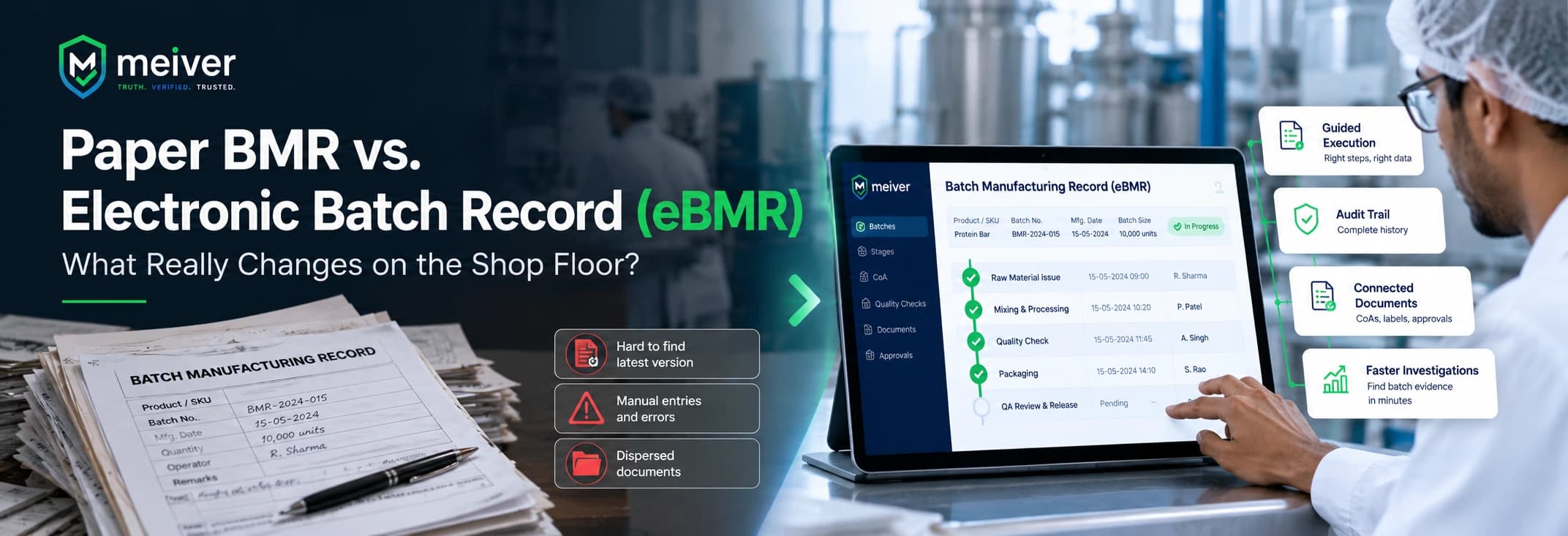
Paper BMR vs. eBMR: What Changes on the Shop Floor?
Shop-floor step | Paper BMR | Electronic BMR |
01. Batch starts | Controlled paper record issued | Controlled electronic batch record initiated |
02. Operator executes | Handwritten entries and manual checks | Guided digital entries with configured controls |
03. Review & approval | Initials, signatures and page-by-page review | Controlled review/e-signature where applicable |
04. Deviations/changes | Written corrections, attachments and manual reconciliation | Exception/change history and audit trail where required |
05. Batch review | Pages compiled, checked and archived | Connected electronic history reviewed and retained |
The visible change is paper versus screen. The operational change is that activities can become part of one controlled batch history as they happen.
What Changes for Operators and QA Teams?
With paper, operators may need to locate the correct document, write observations manually, obtain signatures and attach supporting records. QA later reviews those pages and resolves missing information or inconsistencies.
A properly configured eBMR can guide operators through required steps, capture entries closer to the time of execution and provide controlled review workflows.
That does not mean electronic systems automatically eliminate mistakes.
Shared accounts, weak access controls, editable records or poorly managed audit trails can undermine data integrity just as poor documentation practices can undermine paper records.
WHO therefore applies data-integrity expectations to both paper and electronic records. Its guidance calls for records to follow ALCOA+ principles, including being attributable, legible, contemporaneous, original, accurate, complete, consistent, enduring and available. World Health Organization
Electronic Batch Record Requirements Go Beyond “Paperless”
When manufacturers evaluate electronic batch record software or digital batch record software, the question should not simply be, “Can this replace our paper?”
Controls may need to address areas such as authorised access, user accountability, record reliability, system checks, electronic signatures, retention and appropriate auditability.
For FDA-regulated records, 21 CFR Part 11 is an important reference where required records are maintained electronically or relied upon electronically. The precise requirements, however, depend on the product, jurisdiction and applicable regulatory framework. U.S. Food and Drug Administration
Hybrid approaches can also exist. A manufacturer may use combinations of paper and electronic records provided the applicable requirements remain satisfied.
Where Does Traceability Fit?
A true electronic batch record system focuses on controlled manufacturing execution and documentation.
Traceability answers a related but different question: How does the evidence around that batch stay connected after production?
Meiver is designed around traceability, batch and stage records, supporting quality documents, CoAs and recall workflows—not as a pharmaceutical MES or validated eBMR platform. Meiver Page Structure
That means an eBMR and a traceability platform can serve different layers of the same product-history problem.
A manufacturer may use its validated manufacturing environment to control batch execution, while connected traceability records support downstream verification, investigation and recall readiness.
Conclusion
The move from paper BMR to a paperless batch record is not mainly about removing clipboards.
It is about moving batch execution, review and history into a controlled electronic environment where the appropriate access, integrity, auditability and review controls can be applied.
For manufacturers, the bigger objective should be a trustworthy chain of evidence—from what happened on the production floor to the quality documents and traceability information needed later.
That connected evidence becomes increasingly valuable when a customer, auditor, quality team or recall investigation asks one simple question:
“Show me what happened to this batch.”
[Internal link: Explore Meiver Batch & Stages Management]
FAQs
1. What is eBMR in pharma?
An eBMR in pharma is an electronic batch manufacturing record used to capture and manage manufacturing and quality information associated with a pharmaceutical batch within a controlled electronic environment.
2. Is a scanned BMR considered an electronic batch record?
Not automatically. Scanning a completed paper BMR creates a digital copy, but it does not necessarily create a controlled electronic process for batch execution, review and approval.
3. What are common electronic batch record requirements?
Depending on the regulatory framework, considerations may include controlled access, reliable records, appropriate audit trails, electronic signatures, system controls, retention, review and data-integrity safeguards.
4. Is eBMR the same as ERP or MES?
No. An eBMR describes the controlled electronic batch record and associated execution/review processes. It may be implemented within an MES or another validated manufacturing system, while ERP usually serves broader enterprise processes such as materials, inventory and planning.