Fake products are no longer only a packaging problem. For food, nutraceutical and D2C brands, counterfeits can damage revenue, reputation and, in some categories, consumer safety.
So what works best: a hologram sticker with QR code, a serialized QR, or evidence-backed verification? Usually, not one technology. It is layers.
What Is a Hologram Sticker—and What Does It Actually Prove?
A hologram sticker is a visible security label designed to make packaging harder to imitate or tamper with. An original hologram sticker may use overt, semi-covert or covert features, while hologram sticker labels can incorporate tamper-evident materials and variable printing.
That makes hologram sticker security useful at the physical layer. But appearance alone does not prove origin, batch identity or supporting quality records.
ASPA recommends combining authentication with serialization and traceability rather than relying on one security feature. ASPA Global
QR Codes Add Digital Identity—Not Automatic Authenticity
A standard QR can connect buyers to a website or product page. The weakness is simple: if every pack uses the same code, counterfeiters can copy it.
A QR code hologram sticker becomes more useful when the QR is unique or serialized. Amazon's Project Zero, for example, uses unique codes so enrolled products can be individually checked; Amazon says brands using serialization see the strongest results within the programme. About Amazon India
But serialization still depends on secure code issuance and trustworthy records behind it.
GS1 Digital Link similarly supports identifiers alongside attributes such as batch, expiry and manufacturing information, showing how a QR can become more than a simple website shortcut. GS1 India
Verified Proof Makes the Scan Meaningful
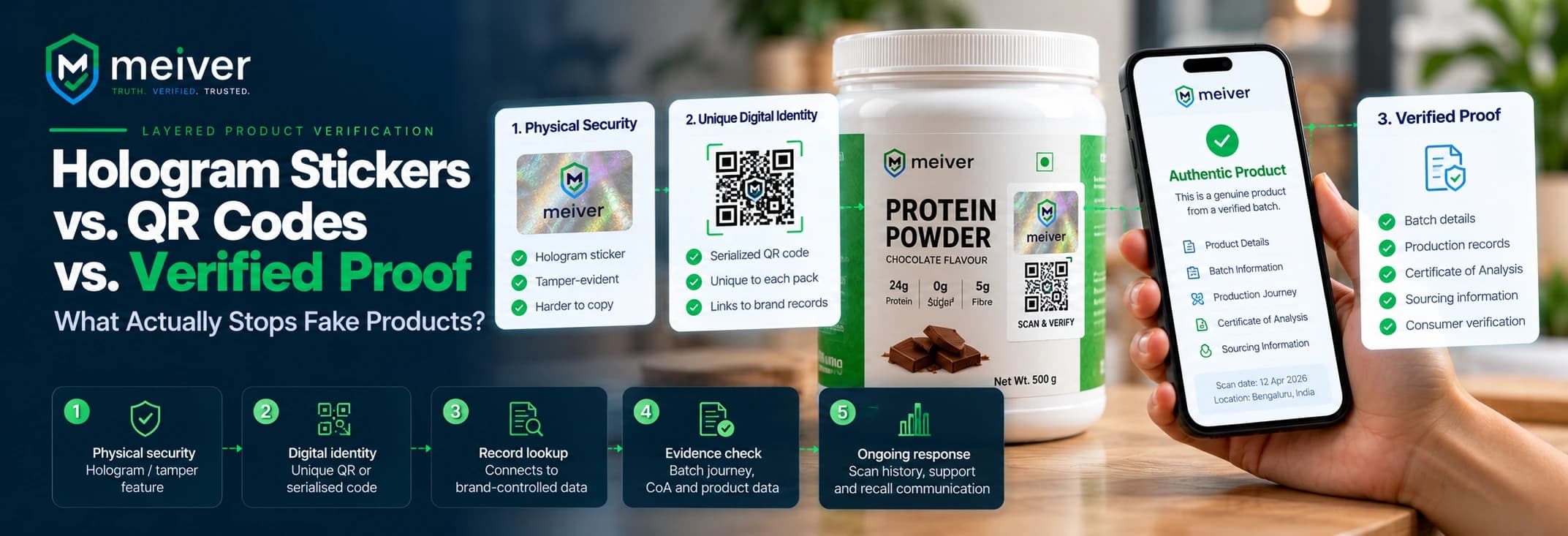
Verified proof connects a product or batch identifier to structured evidence such as batch details, traceability records, production history and Certificates of Analysis.
Meiver follows this model. Its consumer QR experience can surface product and batch identity, production stages, sourcing information and linked CoAs. MeiverFeatureReference Meiver also structures CoA results at batch level so supporting quality evidence can become part of the verification experience. MeiverFeatureReference
That changes the scan from “visit our website” to “show me the evidence for this product.”
Digital proof should not be oversold. Meiver's blockchain anchoring can make a digital batch record tamper-evident through a cryptographic fingerprint; it does not by itself prove that the physical pack is genuine. MeiverFeatureReference
Process Infographic: How Layered Product Verification Works
Step | Protection Layer | What It Achieves |
1 | Physical security | Hologram/tamper feature makes copying or opening harder |
2 | Digital identity | Unique QR or serial distinguishes a pack or batch |
3 | Record lookup | Scan resolves to the relevant brand-controlled record |
4 | Evidence check | Batch journey, CoA and product data can be reviewed |
5 | Ongoing response | Support, scan history or recall communication can continue |
What Should Brands Actually Invest In?
When comparing a hologram sticker manufacturer, look beyond appearance. Ask about tamper evidence, covert features, serialization, variable QR printing, application method and duplication resistance.
Hologram sticker price also varies with quantity, material, security complexity, custom artwork, serialization and variable-data printing. The cheapest option is not always the lowest-risk option.
For modern Indian brands, the better question is not “hologram or QR?” but “what happens when someone checks?”
That check may happen after a retail purchase, marketplace delivery, authenticity search, customer-support complaint or post-purchase scan. A verification layer can turn those moments into qualified trust touchpoints rather than simply sending another visitor to a marketing page.
Conclusion: Stronger Protection Comes From Layers
A hologram helps someone inspect the package. A QR helps someone reach digital information. A unique identifier connected to trustworthy records helps them verify what the package claims to be.
No single sticker or QR code stops fake products. Stronger protection combines physical security, digital identity and evidence-backed verification.
For brands moving from claims to proof, Meiver connects batch traceability, QR verification and supporting evidence into the same consumer-facing journey. Meiver is designed to connect internal batch records with the information shoppers can verify after scanning. MeiverFeatureReference
FAQs
1. What is hologram sticker meaning in anti-counterfeit packaging?
A hologram sticker is a visible security feature designed to make packaging harder to copy or tamper with. It does not prove batch history by itself.
2. Is a hologram sticker with QR code better than a normal hologram?
Potentially—especially when the QR is unique and linked to useful verification records instead of a generic webpage.
3. Can a QR code stop fake products?
Not alone. Static QR codes can be copied. Unique identifiers, trustworthy records and physical security controls create stronger protection.
4. How can Meiver support product verification?
Meiver connects batch-level traceability, QR verification and supporting records such as CoAs, helping brands make product evidence easier for consumers and internal teams to check