For a food manufacturer, “Are you HACCP certified?” can come from a retailer, export buyer, contract-manufacturing client or internal quality team. But the question is often misunderstood.
The key distinction is simple:
HACCP implementation is not the same thing as holding a third-party HACCP certificate.
Indian manufacturers need to separate three things: implementing HACCP-based controls, meeting applicable FSSAI food-safety requirements, and obtaining independent certification.
What Is HACCP Certification?
The HACCP full form in the food industry is Hazard Analysis and Critical Control Point.
HACCP is a science-based system for identifying significant food-safety hazards and establishing controls at points where those hazards can be prevented, eliminated or reduced to acceptable levels. Codex describes HACCP as focusing on control throughout the process rather than relying mainly on finished-product testing. FAOHome
HACCP certification goes one step further: an independent certification body assesses whether an organisation's implemented HACCP system meets the requirements of the applicable certification scheme.
In India, FSSAI states that licensed FBOs must maintain a documented Food Safety Management System (FSMS) plan and comply with Schedule 4. FSSAI also describes an effective FSMS as being based on HACCP and suitable prerequisite programmes. FSSAI
However, this should not be interpreted as a universal requirement for every food manufacturer to hold a standalone third-party HACCP certificate.
What Are the 7 HACCP Principles?
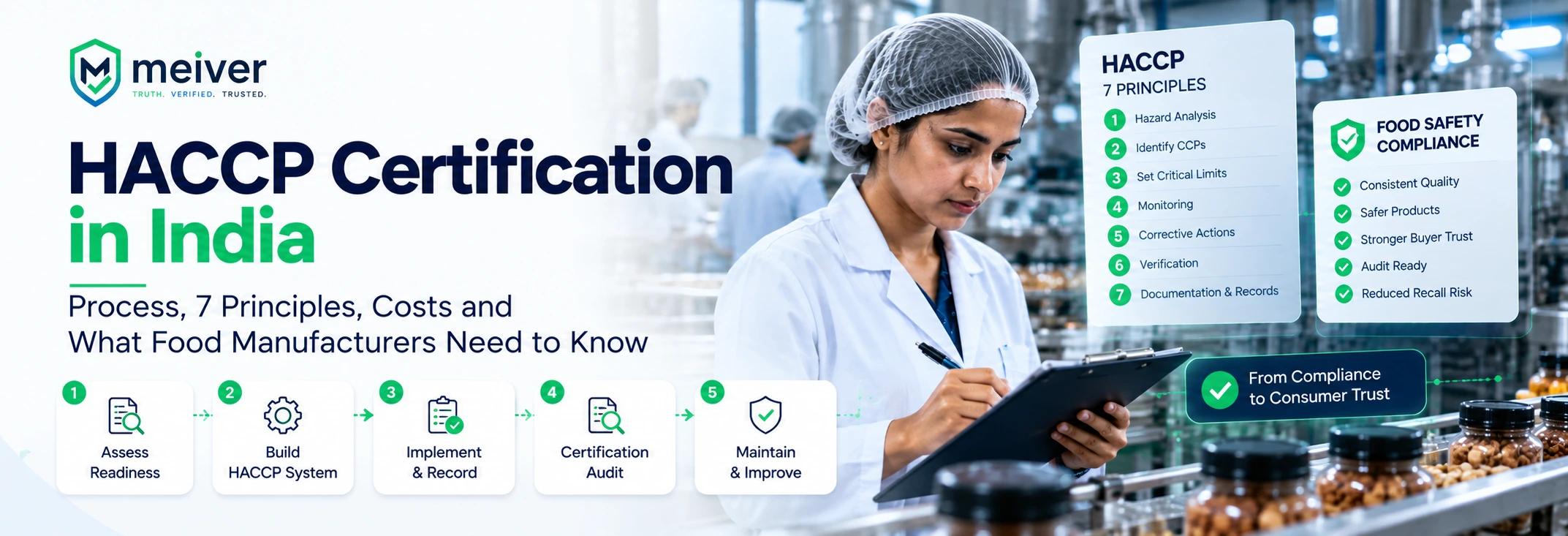
Codex defines the 7 HACCP principles as:
Conduct a hazard analysis.
Determine Critical Control Points (CCPs).
Establish critical limits.
Establish monitoring procedures.
Establish corrective actions.
Establish verification procedures.
Establish documentation and records.
These principles are applied through a broader 12-step HACCP methodology. Therefore, HACCP principles and steps describe how the food-safety system is built; certification describes how that implemented system is independently assessed. FAOHome
HACCP Certification Process in India
For manufacturers asking how to get HACCP certification, the practical journey usually looks like this:
Process Stage | What the Manufacturer Does | Key Output / Evidence |
1. Assess readiness | Review processes, GMP/GHP, PRPs and food-safety gaps | Gap assessment and process flow |
2. Build the HACCP system | Analyse hazards, establish CCPs, limits, monitoring and corrective actions | Documented HACCP plan |
3. Implement and record | Train teams and operate controls consistently | Monitoring, verification and training records |
4. Certification audit | Select an appropriate certification body and undergo assessment | Audit findings and non-conformities |
5. Close and maintain | Complete corrective actions and maintain the system | Certification decision and ongoing surveillance |
For IndiaHACCP, NABCB publishes the scheme's certification criteria, process and current lists of approved or provisionally approved certification bodies. NABCB
IndiaHACCP vs ISO 22000 vs FSSC 22000
Framework | In Simple Terms |
IndiaHACCP | Standalone HACCP certification scheme within India's accreditation ecosystem |
ISO 22000 | Broader food-safety management-system standard incorporating HACCP principles |
FSSC 22000 | Certification scheme combining ISO 22000, sector-specific PRPs and additional FSSC requirements |
FSSC 22000 Version 7 was released in May 2026 and incorporates the updated ISO 22002-x prerequisite-programme series. FSSC
Which route is appropriate can depend on customer requirements, export markets, facility scope and commercial expectations.
What Does HACCP Certification Cost in India?
There is no single official nationwide HACCP certification cost.
Pricing can vary by facility size, processes, number of sites, certification scope, audit duration, workforce, travel, corrective-action follow-up and the selected certification body.
Manufacturers should obtain quotations against the same defined scope and keep certification-audit fees separate from consulting, training or implementation costs.
Why Traceability Still Matters After Certification
A certificate does not remove the need for usable operational evidence.
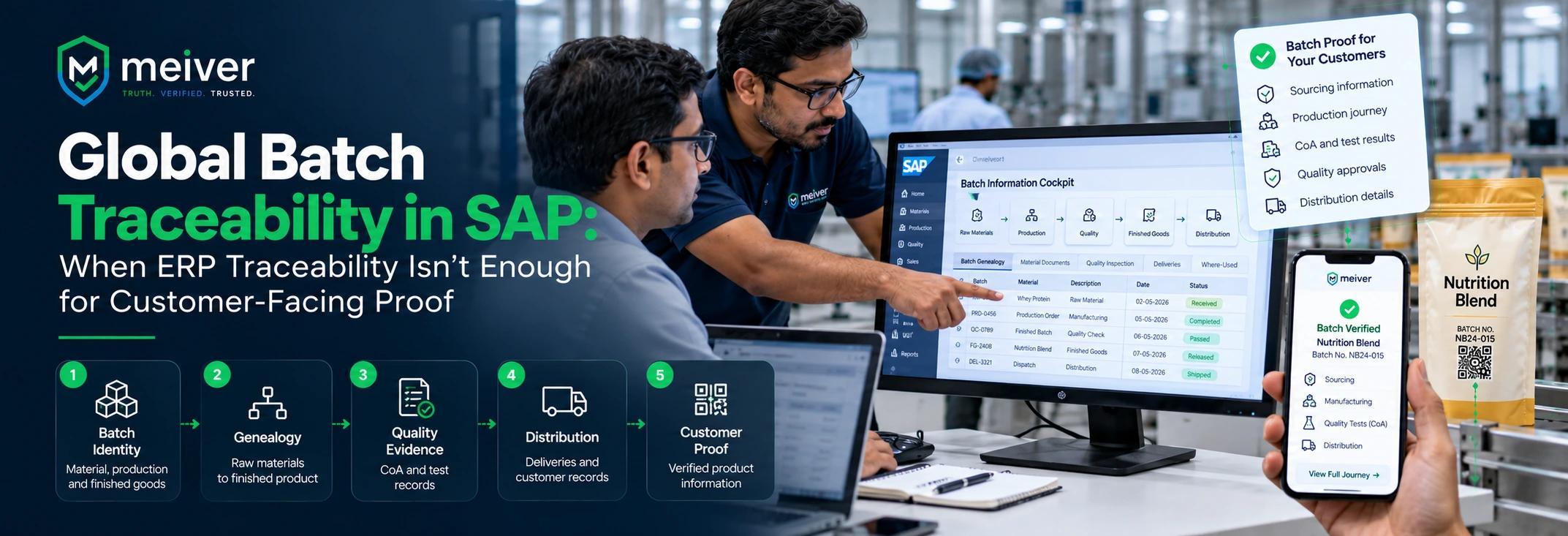
During an audit, complaint or recall, teams may need to retrieve the affected batch history, quality records, supporting documents and test evidence quickly. This becomes particularly important for D2C brands working through contract manufacturers.
Meiver's batch and stage model is designed around production history, supporting documents and operational records, while its CoA capabilities connect quality-test evidence with relevant batches. Meiver_SEO_Master_Plan_v2(1)
HACCP controls food-safety hazards. Traceability helps preserve and retrieve the evidence surrounding batches, quality checks and downstream issues. They support different parts of food-safety assurance.
Conclusion
For Indian food manufacturers, the starting question should not simply be, “Do we need a HACCP certificate?”
First determine your applicable FSSAI FSMS requirements, build effective food-safety controls, understand what customers or export markets expect, and then choose the certification route that fits your business.
As buyer scrutiny grows, well-controlled processes—and the ability to prove what happened to each batch—are increasingly important parts of operating a credible food brand.
FAQs
1. Is HACCP certification mandatory in India?
Not universally. FSSAI requires applicable FBOs to maintain a documented FSMS and comply with Schedule 4, while third-party HACCP certification is a separate requirement unless demanded by a buyer, market, scheme or commercial arrangement. FSSAI
2. What is the HACCP full form?
HACCP stands for Hazard Analysis and Critical Control Point, a preventive system for identifying and controlling significant food-safety hazards.
3. How long does HACCP certification take?
There is no universal timeline. It depends on facility readiness, process complexity, existing documentation, implementation history, audit scheduling and how quickly non-conformities are resolved.
4. Is HACCP the same as ISO 22000?
No. HACCP is a hazard-control methodology. ISO 22000 incorporates HACCP principles within a broader food-safety management-system framework.
Suggested Meiver internal links: Food Traceability Software → Batch Management → Certificate of Analysis Management → Recall Management.