A Digital Product Passport is not becoming mandatory for every Indian product exported to Europe.
Under the EU's Ecodesign for Sustainable Products Regulation (ESPR), food, animal feed, medicines and several biological categories are excluded. For products within scope, Digital Product Passport requirements are introduced progressively through product-specific EU rules—not one universal deadline. Internal Market SMEs
Indian exporters should therefore prepare for the broader shift toward structured, verifiable product evidence without assuming every shipment needs an ESPR passport.
What Is a Digital Product Passport?
A digital product passport (DPP) is a structured digital record associated with a product and accessed through a specified data carrier.
Under the Ecodesign for Sustainable Products Regulation (ESPR), product-specific rules can determine what information must appear, who can access it, which data carrier is required and whether the passport operates at model, batch or individual-item level. EUR-Lex
Priority groups currently include iron and steel, aluminium, textiles/apparel, furniture, tyres and mattresses. But inclusion in the ESPR Working Plan does not automatically make a DPP mandatory. Delegated acts establish the actual requirements and compliance dates. Internal Market SMEs
For Indian companies watching the digital product passport EU market, the first question should therefore be:
Which EU regulation actually applies to our product?
DPP and EUDR Are Separate Regimes
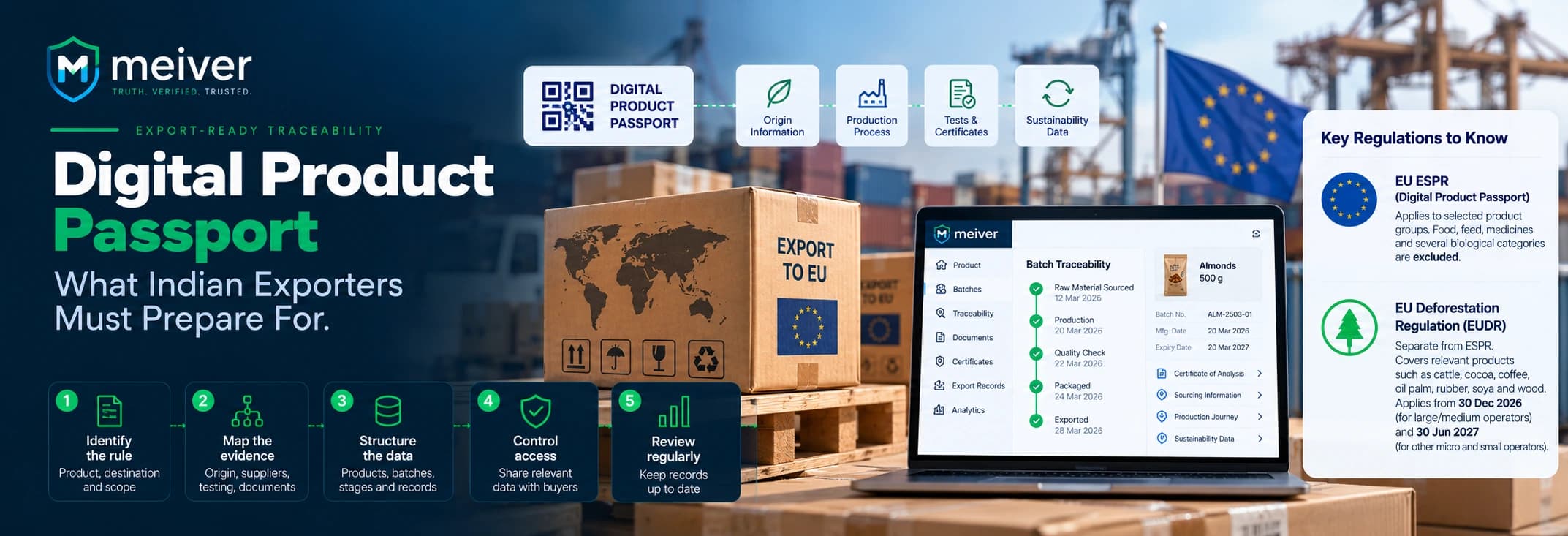
The EU Deforestation Regulation (EUDR) is not part of ESPR or the Digital Product Passport.
EUDR covers relevant products linked to cattle, cocoa, coffee, oil palm, rubber, soya and wood, including specified derived products. Current EUDR regulations apply from 30 December 2026 for large and medium operators and certain micro/small operators previously covered by the EU Timber Regulation, and from 30 June 2027 for other micro and small operators. Environment
So EUDR compliance should never be described as DPP compliance.
However, EUDR requirements demonstrate a wider direction: buyers and regulators increasingly expect traceable origin information, supporting evidence and records that can be retrieved quickly.
What Indian Exporters Should Prepare Now
The goal is to create reusable evidence infrastructure instead of searching through emails, spreadsheets and PDFs every time an importer asks for proof.
Export-Readiness Process
Step | What to prepare | Why it matters |
1. Identify the rule | Product classification, destination and applicable EU regulation | Avoids using the wrong compliance framework |
2. Map the evidence | Origin, supplier, batch, material, testing and sustainability records | Clarifies what information must be captured |
3. Structure the data | Connect products, batches, stages and documents | Reduces fragmented spreadsheets and PDFs |
4. Control access | Define what buyers, regulators and consumers can see | Supports appropriate information sharing |
5. Review regularly | Update records when rules, suppliers or specifications change | Keeps evidence usable as requirements evolve |
Where Meiver Fits
Meiver can help brands organise product and batch evidence through capabilities such as batch management, CoAs, QR verification and traceability records. AI Characters For Banners
But Meiver should not be presented as automatically making an exporter “DPP compliant.”
EU legislation determines the required data, identifiers, access rights, technical standards and passport level. Meiver's role is better understood as helping companies build a structured data foundation that can make buyer due diligence, documentation retrieval and adaptation to emerging traceability requirements easier.
Why This Matters Beyond Compliance
Export readiness is increasingly a trust problem as much as a paperwork problem.
When an importer asks where a material originated, which batch was tested or which document supports a claim, days spent searching for evidence create friction.
Structured records can support faster buyer due diligence, smoother retailer or importer onboarding, clearer product transparency and stronger buyer confidence.
Conclusion
Indian exporters should not assume every EU-bound product needs a Digital Product Passport.
First, determine which regulation applies to the product. Then build reliable product, batch, origin and document records before a buyer or regulator asks for them.
That preparation makes changing digital-traceability requirements easier to absorb—and strengthens product trust at the same time.
FAQs
Is a Digital Product Passport mandatory for all Indian exports to the EU?
No. ESPR excludes categories including food and feed, while DPP obligations are introduced progressively through product-specific rules. Internal Market SMEs
Are food supplements covered by the ESPR DPP?
Food supplements legally marketed as foods fall outside the ESPR framework applicable to food products.
Is EUDR part of the Digital Product Passport?
No. EUDR and DPP are separate legal regimes with different product scopes, evidence requirements and implementation mechanisms.
Can Meiver make a brand DPP compliant?
Meiver can support structured product, batch and document evidence, but compliance depends on the specific EU legislation applicable to the product.