Counterfeit products meaning is simple: goods made or presented to imitate a genuine brand without authorization. Counterfeit products examples include copied packaging, fake cosmetics, imitation supplements or products carrying a duplicated brand identity.
The ASPA–CRISIL State of Counterfeiting in India 2025 survey found that 89% of consumers recognised counterfeit products in the market, while about 27% of consumers who encountered them did not know at purchase that they were fake. These are survey findings about consumer experience and perception—not evidence that the same percentage applies to any individual marketplace. ASPA Global
Why Marketplace Protection Is Only One Layer
Consumers searching “nykaa fake products,” “amazon and counterfeit products” or “amazon flipkart india counterfeit products” are usually asking one thing: Can I trust what I received?
That search behaviour is not proof that a marketplace sells counterfeits. Amazon offers Brand Registry, Project Zero and Transparency. About Amazon India Flipkart Brand Assure lets eligible brands manage authorised sellers and report IP violations. Flipkart Brand Hub Nykaa says its beauty and personal-care business is predominantly inventory-led, sourcing from brands or authorised distributors and conducting warehouse quality checks. Nykaa
Authentication and Traceability Are Different
What is counterfeit products protection trying to solve? Two questions:
Authentication: Is this item genuine?
Traceability: Where did this product or batch come from, and what evidence supports it?
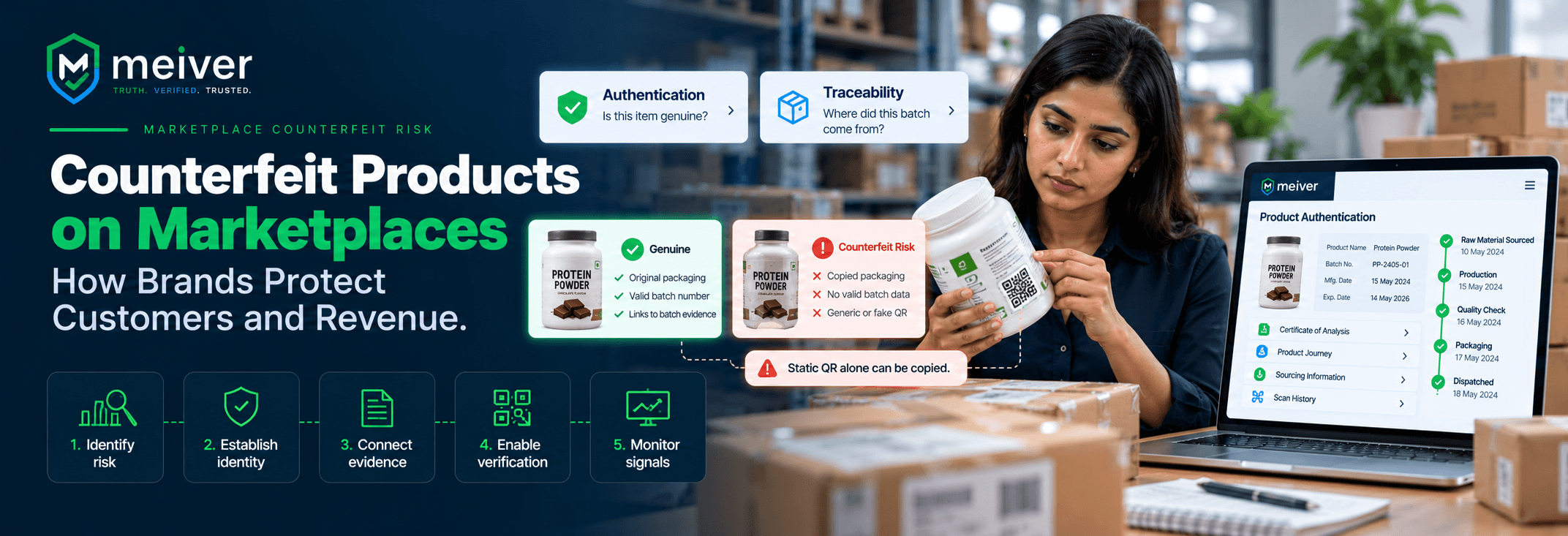
A static QR code printed identically on every pack is not, by itself, an anti-counterfeit system. It can be copied with the packaging.
Stronger product authentication solutions may combine unique identifiers, serialization where item-level proof is required, tamper-evident packaging, controlled code issuance, scan-history analysis and batch-linked evidence. A product authentication card or product authentication page becomes more useful when it connects buyers to verifiable information instead of a generic marketing page.
A Practical Five-Step Protection Process
Step | Brand Action | Value |
1. Identify risk | Map vulnerable SKUs, channels and seller issues | Focus protection where risk is highest |
2. Establish identity | Assign legitimate products or batches controlled identifiers | Create a trusted reference point |
3. Connect evidence | Link batch, origin, CoA and production records | Make claims easier to verify |
4. Enable verification | Give buyers a clear product authentication page | Help customers check before trusting |
5. Monitor signals | Review repeat scans, unusual locations, scan spikes and complaints | Flag cases for investigation—not automatic proof |
Protecting Revenue Means Protecting Trust
Counterfeiting can create lost legitimate sales, support workload, refunds, marketplace disputes, damaged ratings and retailer uncertainty. Channel diversion is different: a genuine product sold through an unauthorised channel is not automatically counterfeit.
Where Meiver Fits
Meiver gives legitimate products a verifiable digital evidence layer. Brands can connect batch identity, production journey, sourcing information and linked Certificates of Analysis to a consumer-facing QR experience. Meiver’s documented consumer pages can expose batch/lot information, journey data and linked evidence while allowing brands to control what information is public. MeiverFeatureReference
Meiver also supports blockchain anchoring by storing a cryptographic fingerprint of a batch record, helping demonstrate that the digital record has not changed after anchoring. It does not make the physical product automatically genuine. MeiverFeatureReference
This does not mean a QR guarantees authenticity or every fake can be automatically detected. It means brands can make the truth behind legitimate products easier to verify—valuable when customers want proof, not promises.
Conclusion
Marketplace controls reduce risk, but customer trust should not end at the listing. Brands that combine protection tools with traceability, evidence and customer-facing verification are better positioned to protect customers, reputation and revenue.
FAQs
1. What is counterfeit products meaning?
Counterfeit products imitate a genuine brand or product without authorization, often using copied names, packaging, trademarks or identity cues.
2. Can a QR code stop counterfeit products?
Not alone. Static QR codes can be copied. Stronger systems combine controlled identity, traceability evidence and, where needed, serialization and tamper protection.
3. What should brands know about Amazon and counterfeit products?
Amazon provides Brand Registry, Project Zero and Transparency. Brands should use marketplace controls alongside their own verification strategy. About Amazon India
4. What is a product authentication page?
It is a customer-facing page used to check product identity or supporting evidence. Its strength depends on the data, identifier controls and physical-to-digital link behind it.