“Has production started?”
“Can you send the latest CoA?”
“Which batch did you dispatch?”
“Was the deviation closed?”
“Where is the test report?”
If these questions arrive every week, the problem may not be communication. It may be visibility.
In many contract manufacturing relationships, the brand depends on the manufacturer for facts that protect its reputation: what was produced, what passed quality checks, what was released and what was shipped. When those answers live across WhatsApp, email, spreadsheets and individual team members, every update becomes a chase.
Transparency is not sending more messages. It is reducing how often the client has to ask for basic operational truth.
What Is Contract Manufacturing—and Where Does Trust Break?
If you are asking what is contract manufacturing, the contract manufacturing meaning is straightforward: a brand outsources some or all manufacturing activities to a third-party specialist under agreed specifications and commercial terms.
A contract manufacturing organisation, or CMO, is not only producing goods. It is also holding evidence the brand may need for quality reviews, complaints and recalls. The phrase “cmo contract manufacturing organisation” may sound repetitive, but the expectation is simple: brands want a partner they can rely on without constant follow-up.
Visibility Is Part of the Contract Manufacturing Service
Operational transparency does not mean exposing confidential formulas, trade secrets or every internal plant record. It means giving the client timely, permission-appropriate access to the evidence it legitimately needs.
That may include the approved specification, batch number, production status, quality checkpoints, CoA or test evidence, relevant deviations, release status and dispatch details.
For a manufacturer, this can become a competitive advantage. Two plants may offer similar capability and pricing, but the one that makes status and evidence easier to verify often feels easier to work with. That matters when brands decide who receives the next SKU or production run.
A Practical Contract Manufacturing Example in India
Consider a growing nutrition brand using a third-party manufacturer. The brand is preparing a marketplace launch and asks whether Batch 2408 has been released.
Sales checks with QA. QA searches for the report. Production confirms the batch is complete. Dispatch has a different batch reference in a spreadsheet. The client waits.
This contract manufacturing example shows that the problem is not necessarily poor manufacturing. It is fragmented evidence.
For teams comparing contract manufacturing India partners—or searching for an example of contract manufacturing in India—the stronger question is not only, “Can you make our product?” It is also, “How quickly can you prove what happened to our batch?”
Make Every Batch Easier to Trust
The operating model is simple:
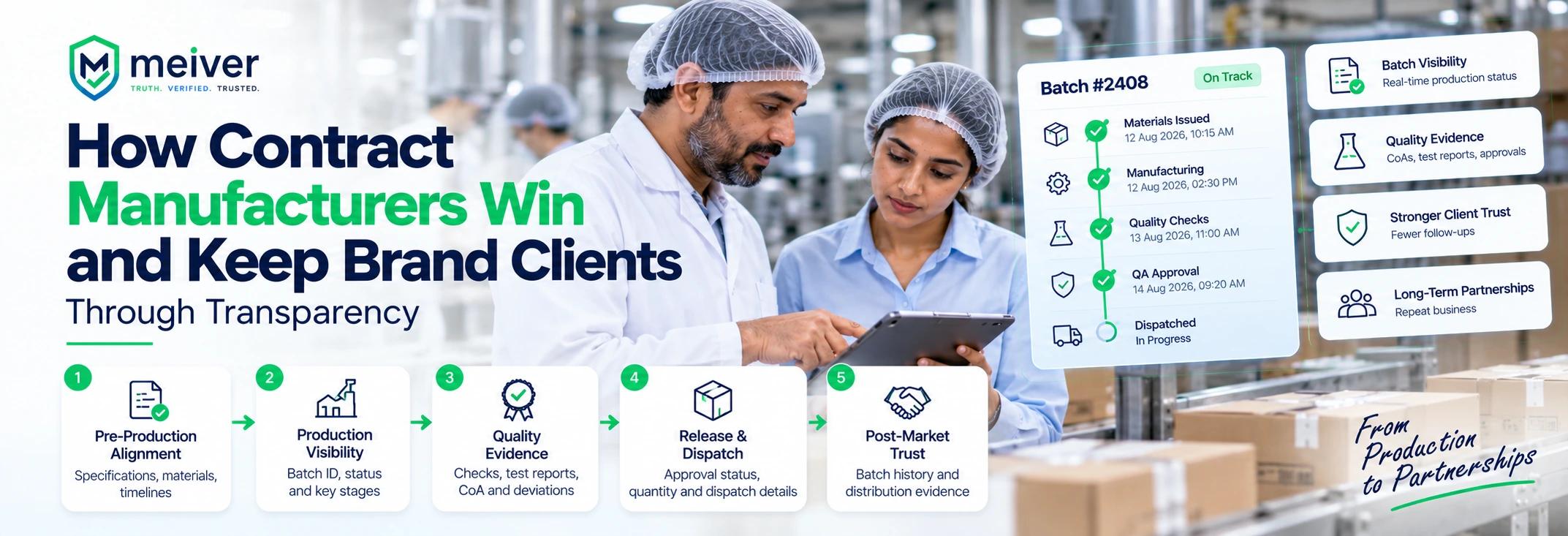
clear batch identity → visible stage progress → linked quality evidence → release status → dispatch and recall-ready history
Meiver is designed around connected batch evidence. Its batch records can link products, supporting documents, approvals, comments and lifecycle status, while stage records can capture who performed an activity, when, where and with process-specific data. MeiverFeatureReference MeiverFeatureReference
Authorised teams can retrieve the story of a batch without rebuilding it from scattered conversations. Meiver can also connect Certificate of Analysis information to the batch and support structured release and approval workflows. MeiverFeatureReference
Transparency Helps You Keep the Client, Not Just Win Them
India contract manufacturing relationships are often built through capability, pricing and personal trust. But repeat business depends on what happens after the purchase order.
When a client can get reliable answers quickly, routine status calls reduce, escalations become easier to handle, and quality conversations become more evidence-based. In a complaint or recall situation, organised batch and distribution evidence can support faster investigation.
For contract manufacturers, transparency is not an extra dashboard feature. It is part of client experience.
The manufacturers that become long-term partners are the ones that make the relationship easier to trust: the right evidence, at the right time, for the right people.
Process Infographic: From Production Order to Long-Term Trust
Stage | What the brand needs to see | Trust outcome |
Pre-production alignment | Approved specification, materials, timelines and responsibilities | Fewer surprises before production |
Production visibility | Batch ID, status and key stage progress | Fewer “has production started?” follow-ups |
Quality evidence | Checks, test reports, CoA and relevant deviations | Evidence replaces reassurance |
Release & dispatch | Approval/release status, quantity and dispatch details | Clear handover and accountability |
Post-market / recall readiness | Batch history and relevant distribution evidence | Faster investigation when something goes wrong |
FAQs
What is contract manufacturing?
Contract manufacturing is an arrangement in which a brand engages an external manufacturer to produce goods according to agreed formulations, specifications, quality requirements and commercial terms.
Why is transparency important in contract manufacturing?
Transparency helps brands understand what is happening with their product without repeatedly chasing sales, QA or production teams. Clear batch status, quality evidence and release information can reduce uncertainty and strengthen the working relationship.
What should brands look for when choosing a contract manufacturer in India?
Beyond manufacturing capability, price and capacity, brands should evaluate how the manufacturer handles specifications, batch identification, production updates, quality records, CoAs, deviations, approvals, dispatch evidence and complaint or recall investigations.
How can Meiver support contract manufacturing relationships?
Meiver can help keep batch, stage and quality evidence connected so authorised teams can retrieve relevant production information without rebuilding the history from separate emails, spreadsheets and messages. Its documented capabilities include batch lifecycle tracking, linked supporting documents, approvals and structured production-stage records. MeiverFeatureReference