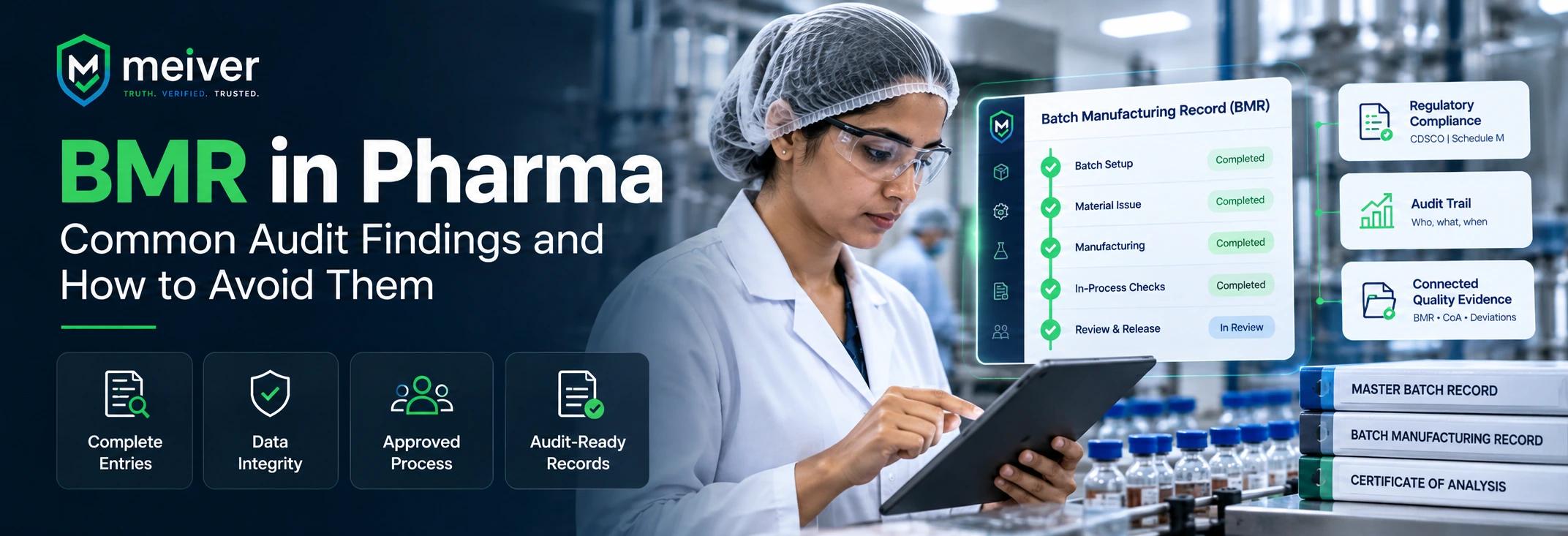
A BMR in pharma is more than a production form. It is the evidence trail for a specific batch: what was manufactured, which materials and equipment were used, who performed each activity, what happened during processing, and whether the batch followed the approved instructions.
India’s revised Schedule M was notified through G.S.R. 922(E) on 28 December 2023. CDSCO subsequently allowed eligible manufacturers with turnover up to ₹250 crore to seek additional implementation time, but not beyond 31 December 2025. As of 2026, manufacturers should therefore assess their documentation against the revised framework rather than rely on the older implementation timeline. CDSCO
What Is a BMR in the Pharma Industry?
The batch manufacturing record in pharmaceutical industry documentation shows what actually happened during one manufacturing batch.
It helps to separate two concepts:
Master Formula / Master Batch Record: approved instructions describing how the product is intended to be manufactured.
BMR / executed batch record: completed evidence showing how a particular batch was actually manufactured.
Terms such as BPR BMR in pharma or BPCR may also be used by different organisations, but terminology is not completely uniform.
CDSCO requirements for Master Formula Records include raw-material quantities, equipment, manufacturing and control instructions, critical parameters, theoretical yields and in-process testing. CDSCO
Common BMR-Related Audit Findings
Most BMR problems are not caused by the absence of a form. They arise when the record cannot reliably reconstruct what happened.
Common audit-risk patterns include:
missing, incomplete or delayed entries;
unexplained corrections or overwriting;
missing operator or reviewer signatures;
undocumented deviations;
material quantity or yield discrepancies;
incomplete reconciliation;
missing in-process results;
uncontrolled attachments; and
failure to follow the approved Master Formula or SOP.
The practical rule is simple: record the activity when it happens, identify who performed it, and document exceptions rather than trying to reconstruct them later.
BMR Audit-Readiness Process
Manufacturing stage | What the BMR should capture | Audit-risk control |
Batch setup | Product, batch number, approved formula/reference | Prevent wrong-document use |
Material issue | Material lots, quantities, dispensing details | Maintain traceability and reconciliation |
Processing | Equipment, operators, timings, critical parameters | Prove contemporaneous execution |
In-process/QC | IPC results, deviations, yields, reviewer checks | Support quality and release decisions |
Review/release | Reconciliation, deviations, approvals, final status | Confirm controlled batch closure |
Electronic Batch Records: Better Control, New Responsibilities
An electronic batch record in pharma can reduce handwriting issues, missing fields and document retrieval delays—but digitisation alone does not create compliance.
Computerised GMP systems require appropriate validation, controlled access, backups and audit trails. WHO guidance expects relevant audit trails to preserve changes, identify users and timestamps, and allow activities to be reconstructed. World Health Organization
So when assessing electronic batch record software for pharma, manufacturers should evaluate governance and data integrity, not simply whether the system replaces paper.
From BMR Completion to Batch Record Release
Batch record release should happen only after the required manufacturing, reconciliation, deviation and quality evidence has been reviewed.
The BMR and Certificate of Analysis serve different purposes. The BMR documents execution of manufacturing; the CoA reports specified analytical results. CDSCO rules also require testing records for raw materials and finished-product batches. CDSCO
For brands managing multiple batches, evidence can become fragmented across paper files, spreadsheets and shared folders. Meiver is designed around batch-level traceability, linking batches with production stages, supporting documents and quality evidence rather than acting as an ERP or eBMR execution system. MeiverFeatureReference
Conclusion
A strong pharma batch manufacturing record should answer five questions without guesswork: what happened, who did it, when it happened, whether the approved process was followed, and how exceptions were handled.
Good BMR discipline therefore protects more than audit readiness. It strengthens traceability, investigation quality, recall readiness and confidence in every released batch.
FAQs
1. What is the difference between a master batch record vs executed batch record?
The master record contains approved manufacturing instructions. The executed record documents what actually occurred for a specific batch.
2. Is an electronic BMR mandatory in India?
Not generally. Electronic systems can improve control, but manufacturers must manage validation, access, audit trails, security, backups and data integrity appropriately.
3. What are GMP Certificate of Analysis requirements in relation to BMR?
For GMP certificate of analysis requirements, think of the CoA as analytical evidence supporting quality decisions. It complements—but does not replace—the manufacturing record.
4. Can traceability software replace the BMR?
No. Traceability systems can connect batch, stage and quality evidence, but they should not automatically be treated as a validated BMR, MES or QMS unless their validated intended use supports that function.
Suggested internal links: Meiver Pharma Solutions, Batch & Stages Management, Certificate of Analysis, Traceability, and Recall Management pages. Meiver’s site structure specifically positions its Pharma solution around batch tracking, CoA proof, regulatory support and verified product trust. Meiver Page Structure
This structure also aligns with Google’s current guidance: useful, original, people-first information remains foundational for both conventional Search and generative AI experiences; Google does not require a separate AEO/GEO optimisation system.