A customer complaint is rarely the hardest part. The harder question is: which batch was affected, what went into it, and what happened during production?
That is where a Batch Manufacturing Record, or BMR, becomes valuable. For food and nutraceutical brands, it is evidence for one specific batch.
What Is a Batch Manufacturing Record?
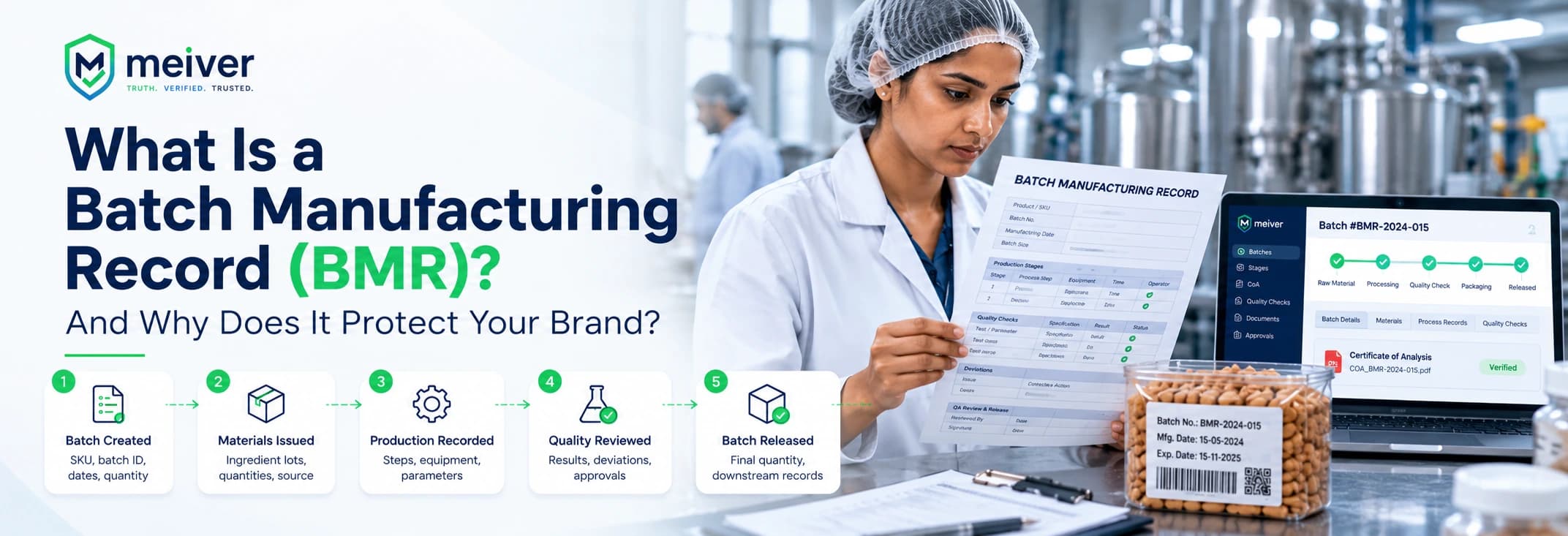
If you searched “what is batch manufacturing record,” the simplest batch manufacturing record definition is: a controlled, batch-specific record of the materials, process steps, checks, deviations and approvals associated with manufacturing a particular batch.
It should show what actually happened—not only what was supposed to happen.
FSSAI’s June 2026 amendment to the Licensing and Registration Regulations requires manufacturing food businesses to maintain daily records of production and raw-material utilisation separately. This should not be confused with a universal, prescribed BMR format for every food product. FSSAI
BMR vs Master Batch Record vs SOP
Master Batch Record / Master Formula: approved manufacturing instructions.
BMR / executed batch record: completed evidence for one manufacturing run.
SOP: a controlled procedure explaining how a recurring activity should be performed.
The master batch record meaning is essentially “how the batch should be made”; the BMR shows how that batch was made. A batch manufacturing record SOP may govern how records are completed and reviewed.
Why Batch Manufacturing Record Is Important
The importance of batch manufacturing record discipline becomes clear when something goes wrong.
A complaint may require the team to identify the batch, check ingredient lots, review processing conditions, examine deviations and confirm quality evidence. Good records make that investigation faster and more defensible.
This matters when a brand owns the customer relationship but a contract manufacturer holds production evidence. Disconnected records can turn a simple question into calls, spreadsheets and PDF chases.
What Is Batch Record Review?
Batch record review confirms required information is complete, results are acceptable, deviations are documented and the necessary approvals are in place before release.
WHO pharmaceutical GMP guidance includes items such as batch identity, starting-material quantities, operators, equipment, in-process controls, yields and deviations. WHO also defines batch records as documents that provide the history of a batch and circumstances relevant to final-product quality. This is useful pharmaceutical context, not a blanket rule for every FSSAI-regulated food manufacturer. WHO Extranet
Batch Record Process: From Production to Protection
Stage | What gets recorded | Why it protects the brand |
1. Batch created | Product/SKU, batch ID, date, planned quantity | Establishes a unique identity |
2. Materials issued | Raw-material lots, quantities, source references | Connects inputs to finished batch |
3. Production recorded | Process steps, equipment, operators, timestamps, key parameters | Shows what happened |
4. Quality reviewed | Results, deviations, approvals, supporting evidence | Creates a reviewable quality trail |
5. Batch released & traced | Release decision, final quantity, downstream records | Supports investigation and recall response |
Where Meiver Fits
A BMR tells you what happened during production. The bigger challenge is keeping that evidence connected to the batch so your team can retrieve it when a buyer, regulator or customer needs answers.
Meiver’s broader product-trust approach is built around helping businesses connect batch management with CoAs, verification, recalls and traceability. meiver_business_solutions_Page Its documented site structure positions batch workflows, supporting documents, consumer QR verification and recall management as connected parts of product traceability. Meiver Page Structure
Verified batch information can also support QR-led product pages, authenticity checks and post-purchase education—without turning the BMR itself into a marketing tool.
Conclusion
Why batch manufacturing record is important? Because trust becomes practical when evidence can be retrieved.
A well-maintained BMR helps a brand investigate problems, answer questions and assess affected scope with greater confidence.
The goal is not more paperwork. It is better-connected proof.
FAQs
What should a BMR contain?
Common fields include batch identity, material lot numbers, quantities, processing details, checks, deviations, yields and approvals.
What is batch record review?
It is the documented review of a completed batch record for completeness, accuracy, exceptions and release readiness.
What do batch manufacturing record WHO guidelines say?
Batch manufacturing record WHO guidelines in the sources cited here relate to pharmaceutical GMP and describe detailed executed batch records. They are useful context, not a universal Indian food requirement. WHO Extranet
Is a batch manufacturing record SlideShare or template enough?
A batch manufacturing record SlideShare, PDF or Excel sample can explain structure, but it should not replace a controlled record designed for the actual product, process, facility and quality system.