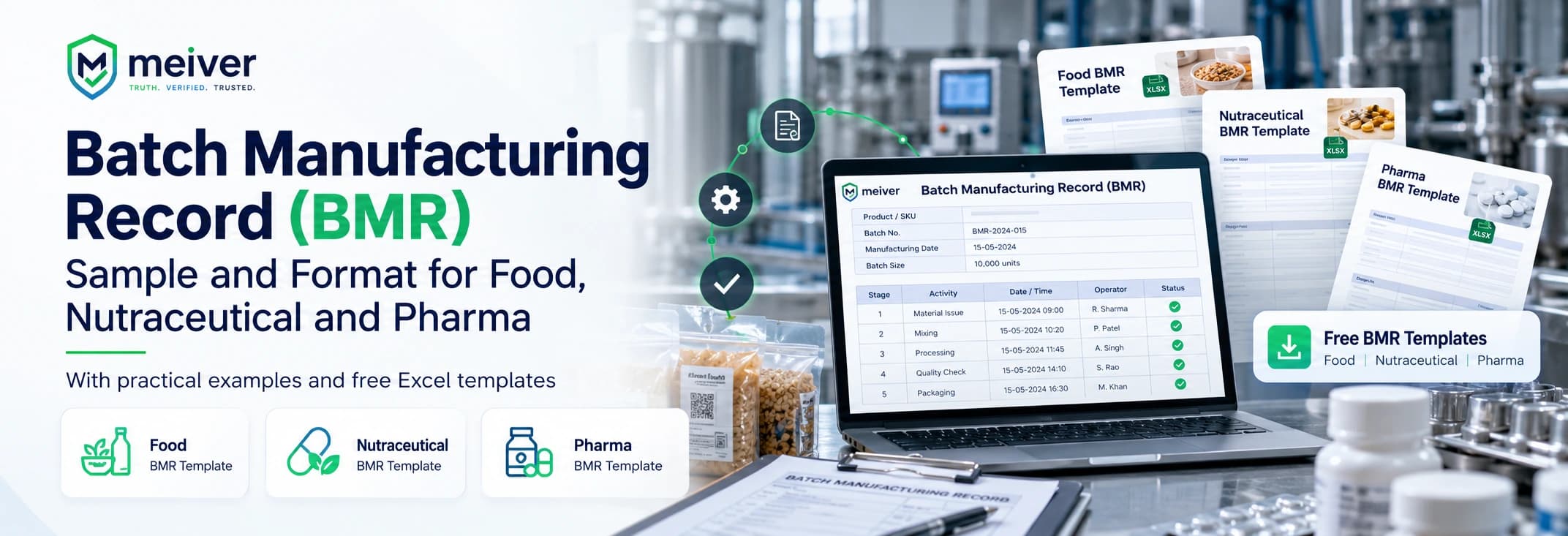
A batch manufacturing record (BMR) is the batch-specific record of what actually happened during production: materials used, steps completed, checks performed, yields, deviations and approvals. A master formula or SOP says what should happen; the BMR records what did happen.
What should a batch manufacturing record contain?
A practical batch manufacturing record sample usually covers five evidence groups: batch identity, material traceability, manufacturing activity, quality checks and batch closure.
For nutraceuticals, FSSAI guidance identifies records such as BOM, manufacturing formula, process flow, manufacturing instructions, packaging information, significant manufacturing steps, operational controls, testing, traceability and deviations. It also states that manufacturing or batch records should be checked at each level and approved by QA. FSSAI
Pharma documentation is more formal. CDSCO’s framework connects batch manufacturing records with approved master documentation covering materials, equipment, critical-process parameters, expected yields and in-process quality controls. CDSCO
Process infographic: how the BMR follows the batch
Stage | What gets recorded | Why it matters |
01. Batch setup | Product, batch/lot number, approved batch size, master/specification reference | Establishes batch identity |
02. Material issue | Material names, lot/reference numbers, quantities and source records | Links inputs to the batch |
03. Manufacturing | Process steps, equipment, parameters, operators and timestamps | Creates production history |
04. Quality & release | In-process checks, results, yields, deviations and approvals | Supports release decisions |
05. Closure & traceability | Packaging, reconciliation, final quantity and downstream records | Supports investigation and recall |
Food and nutraceutical BMR formats
A food batch manufacturing record format should reflect the facility’s FSMS, product specification and operating controls. Common fields include material lots, processing stages, relevant controls, packaging, yield/reconciliation, deviations and review.
A nutraceutical batch manufacturing record sample format normally adds BOM/formula references, process flow, label and packaging controls, testing, CAPA and QA approval.
Pharma BMR/BPR: tablets and syrup
A batch manufacturing record for tablets, or tablet batch manufacturing record, should be executed against approved master documentation. The same principle applies to a batch manufacturing record format for syrup.
A pharmaceutical batch record example may show product name, batch number, MFR reference, material/control numbers, equipment, significant steps, IPC results, yields, deviations and QA disposition.
For a paracetamol batch manufacturing record, do not treat an internet sample as a manufacturing instruction. A pharma batch record template should show structure without supplying unapproved formulation quantities or process settings.
Illustrative sample only — not an approved Master Formula, manufacturing instruction, validation document or regulatory-ready batch record.
Free batch manufacturing record format Excel downloads
Rather than one universal batch manufacturing record format Excel file, use a template designed for your sector:
Each should be customised to the relevant product, licence, SOPs, specifications and quality system before operational use.
Why connected batch evidence matters
BMRs, CoAs, packaging evidence and approvals often sit in different files. Meiver’s documented positioning includes batch-level workflows, complete production records, document proof and recall support. Meiver Page Structure
A BMR records the manufacturing event. Keeping related batch, stage and supporting evidence connected can make later QA review and traceability easier.
Internal-link opportunities: link Batch & Stages Management, CoA Management, Traceability and Recall Management to their relevant Meiver pages.
Conclusion
A good BMR is the evidence trail for one batch. Use a sector-appropriate format, tie the executed record to approved documentation, and keep the evidence retrievable for QA, buyers, audits and investigations.
FAQs
1. What is the difference between BMR and BPR?
BMR commonly means Batch Manufacturing Record; BPR may mean Batch Processing or Production Record. Use the terminology defined by your quality system.
2. Can one template cover food, nutraceutical and pharma?
Not well. The core purpose is similar, but regulatory detail and controls differ.
3. Can Excel be used for a BMR?
It can structure records, but suitability depends on approved procedures, controls, data-integrity needs and applicable regulation.
4. Is a sample pharma BMR ready for manufacturing use?
No. It is a drafting reference; actual records must follow authorised master documentation and site procedures.