A batch manufacturing record (BMR) is the evidence trail for one production batch: what materials were used, what happened during processing, what checks were completed, what was packed and who approved release.
For Indian food and nutraceutical manufacturers, a good BMR supports QA review, traceability, buyer requests and investigations. FSSAI’s nutraceutical guidance says Manufacturing or Batch Records should be checked at each level and approved by QA, with deviations documented, justified and approved. It also identifies BOM, manufacturing formula, process flow, manufacturing instructions, packaging information and records for significant manufacturing steps. FSSAI
What Is a Batch Manufacturing Record?
A batch manufacturing record in food industry operations is usually the completed record for a specific production run.
Its exact structure can vary by product, process and quality system. FSSAI expects food businesses to maintain documented food-safety systems and applicable manufacturing records, but it does not prescribe one universal BMR spreadsheet for every food manufacturer. Licensed food businesses are expected to maintain a documented FSMS and comply with applicable Schedule 4 GMP/GHP requirements. FSSAI
A useful manufacturing batch record should show:
Raw-material and packaging lots used
Processing steps and important operating parameters
In-process or finished-product checks
Deviations and yield/reconciliation differences
Review and release decisions
BMR vs BPR vs Master Batch Record
Batch Manufacturing Record (BMR) and Batch Production Record (BPR) are often used interchangeably. Some organisations distinguish manufacturing from packaging or broader production records; others do not. Therefore, batch manufacturing record vs batch production record is not a universal legal distinction.
A master batch manufacturing record, master formula or master production instruction describes how a product should be made. The executed BMR records what actually happened for one batch.
WHO similarly describes batch records as documents associated with manufacturing a batch that provide its history and circumstances relevant to final product quality. WHO Extranet
How to Prepare a Batch Manufacturing Record
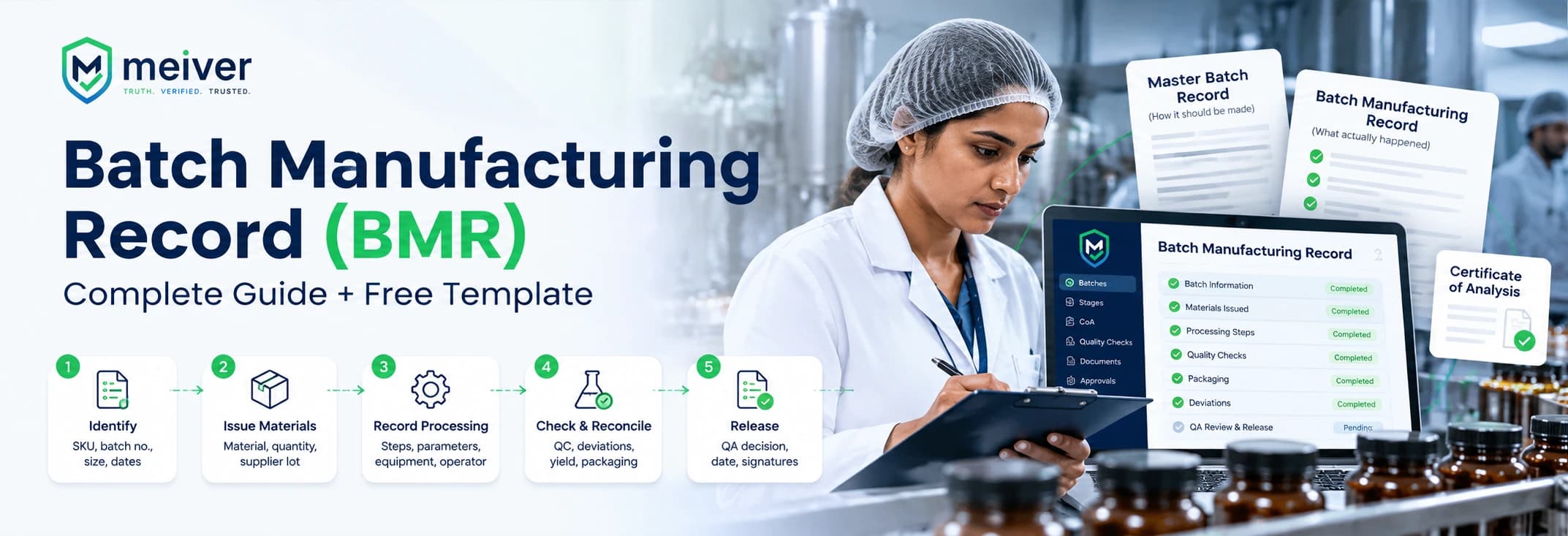
Use this five-step process infographic:
Process | What to Record | Purpose |
1. Identify | SKU, batch/lot number, BMR number, size, dates | Establish batch identity |
2. Issue Materials | Material, quantity, supplier/material lot | Trace inputs |
3. Record Processing | Step, time, equipment, parameters, operator | Document manufacture |
4. Check & Reconcile | QC, deviations, yield, packaging reconciliation | Support QA review |
5. Release | QA decision, date, signatures | Close the batch record |
Free Batch Manufacturing Record Excel Template
For a practical batch manufacturing record Excel template, use these sections:
Batch identification: Product/SKU, BMR number, batch number, batch size, manufacturing date
Materials: Ingredient/material, target and actual quantity, supplier/material lot
Processing: Step, date/time, equipment, parameters, operator
QC: Check, specification, result, status, inspector
Packaging: Packaging lot, label version, packed quantity, reconciliation
Deviations: Issue, investigation/reference, corrective action, approval
Yield: Theoretical yield, actual yield, variance
Release: QA review, decision, date, signatures
This is a starting framework—not a claim that FSSAI mandates this exact layout.
Why Batch Record Management Should Go Beyond Excel
A common ground-level problem is fragmentation: the BMR sits in Excel, the CoA in a shared folder, approvals in email and recall evidence elsewhere.
Effective batch record management keeps that evidence connected.
Meiver can associate batches with SKUs, supporting documents, approvals, notes and production-stage history. MeiverFeatureReference Its stage model can capture who performed an activity, when and where it occurred, together with process-specific information. MeiverFeatureReference
That makes Meiver useful as batch manufacturing record software in the broader traceability sense—not an ERP replacement, but a digital layer connecting batch history with quality and traceability evidence.
Conclusion
A strong BMR shows how a batch was made, checked, packaged and released. Its value grows when that evidence remains connected throughout the product lifecycle—especially when QA teams, buyers or recall teams need answers quickly.
FAQs
1. Is a BMR mandatory for every food manufacturer?
Applicable manufacturing, quality and FSMS records are required, but the exact BMR layout depends on the product, regulations and quality system.
2. What is the difference between a BMR and a master batch record?
The master record contains approved instructions; the executed BMR records what happened for one specific batch.
3. Can Excel be used for BMRs?
Yes, provided the manufacturer keeps records controlled, accurate, reviewable and retrievable.
4. Why digitise BMR-related records?
Digitisation can reduce document chasing and make batch evidence easier to retrieve during QA reviews, buyer requests, investigations and recalls.